
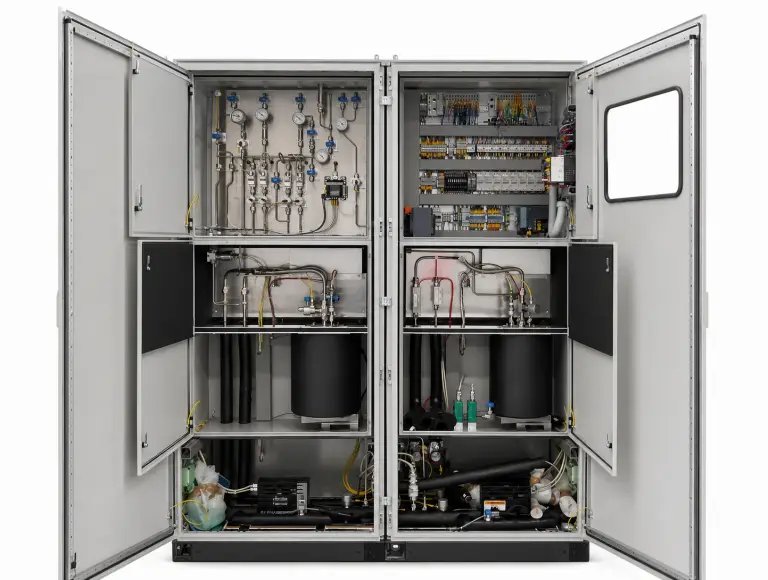
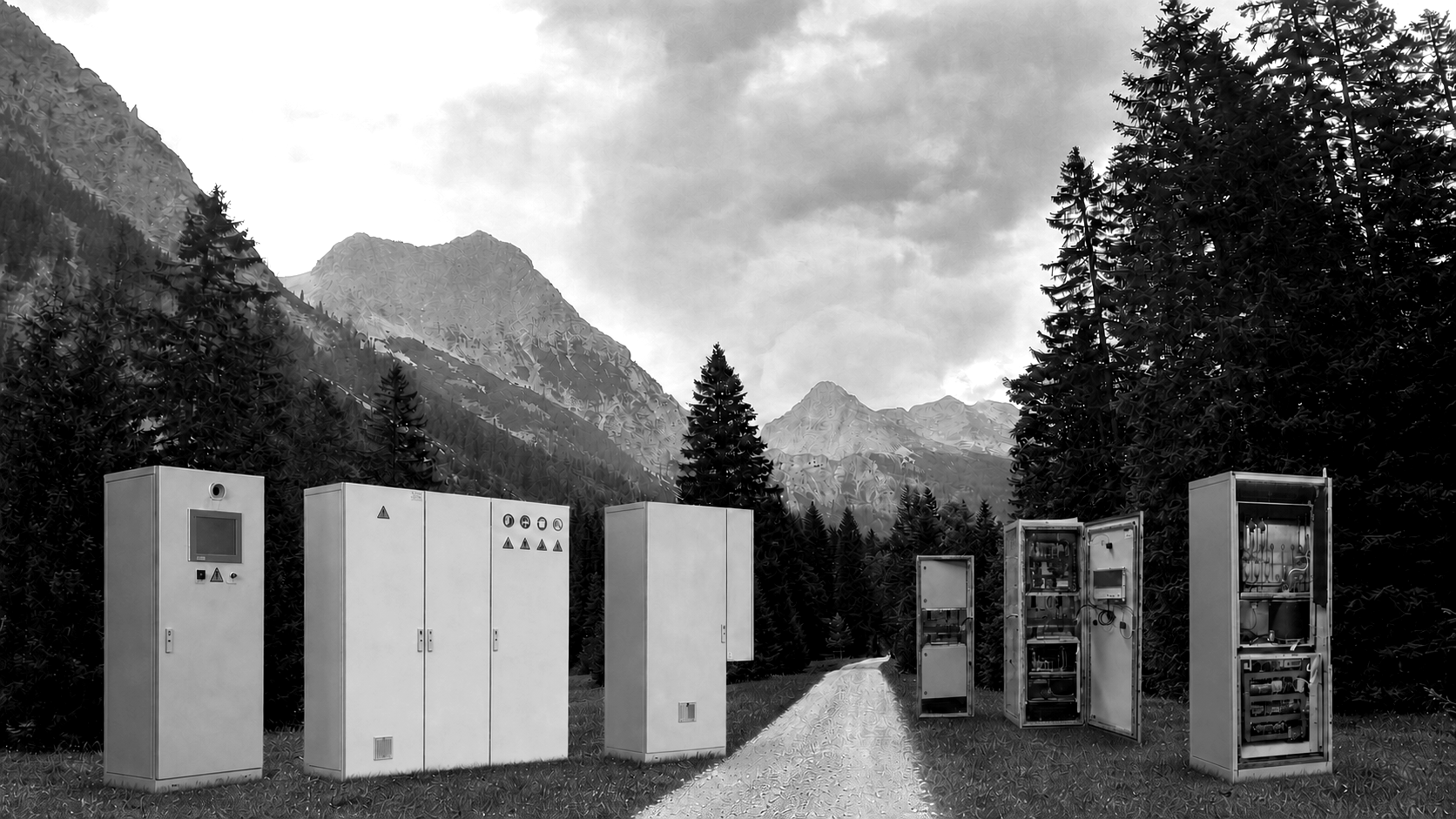
Actual system image, visually enhanced using AI; errors may occur.
Precursor vaporizer systems
SIGA’s precursor evaporation systems enable the precise, carrier-free dosing and evaporation of liquid chemicals for CVD, PECVD, ALD and other deposition processes – safely, efficiently and cost-effectively.
We respond to our customers’ requirements, develop solutions in line with their specifications and tailor our systems to their needs.
- Direct evaporation without a carrier gas
- Evaporation using a carrier gas
- Mixture following vaporisation with any process gases
- Massenflusskontrolliert oder Charge and Release über Puffergefäß
- Use of all standard technologies: direct evaporators, bubblers, DLI, C&R
- Optimal in Kombination mit unserem Precursor Versorgungssystem G504
- Realisierung als dauerhaft dichte Systeme durch metallische Dichtungen
- Verwendung von Reinstgaskomponenten in UHP Qualität
Platform V107 / V108 precursor vaporizer for one precursor and one process outlet
Our precursor vaporizers, based on the "baking" principle, allow for the dosing of the correct amount of precursor without the use of a carrier gas.
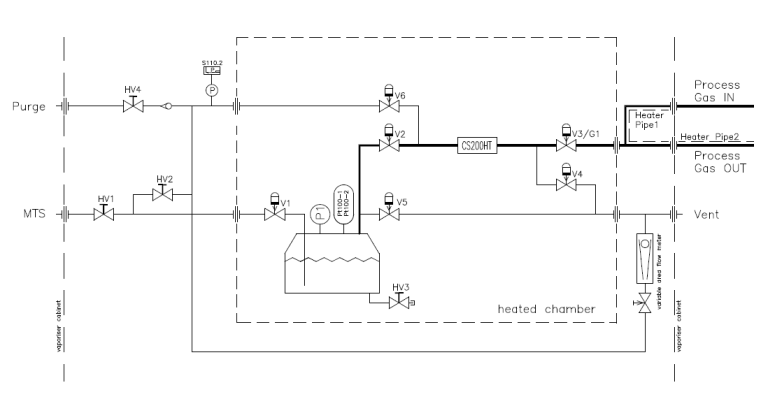
The V107/V108 base system comprises an evaporator with a rinse inlet and one process outlet. Various configuration options are available, such as dosing into a process gas stream and the mixing of different vapours and gases. Where required, features such as controlled inerting of the exhaust gas stream, pressure relief valves, gas sensors, ventilation systems, back-pressure regulators and other process-specific components can be added.
There are now more than a dozen versions of the system, which we would be happy to tailor further to your requirements.
- Direct evaporation without a carrier gas
- Mass flow-controlled (typically 50 g/h to 2000 g/h depending on the medium)
- Evaporator vessel 5.2 l, capacity 3.5 l, -1 to +5 bar
- Rinsing function with pressure-switch rinsing
- Vollständig beheizter Prozessgasraum
- Permanently technically leak-proof
- Routines for refilling, rinsing and commissioning
- Automatische Nachfüllung im Prozess in Kombination mit unserem Precursor Versorgungssystem
- Configurable interfaces for control (ADS, Profinet, EtherCAT, WEB-HMI, and many more)
- Price on request
- Typical lead time 8–16 weeks
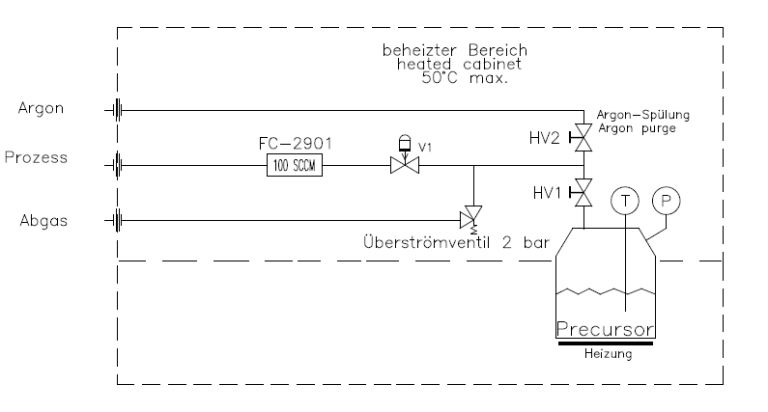
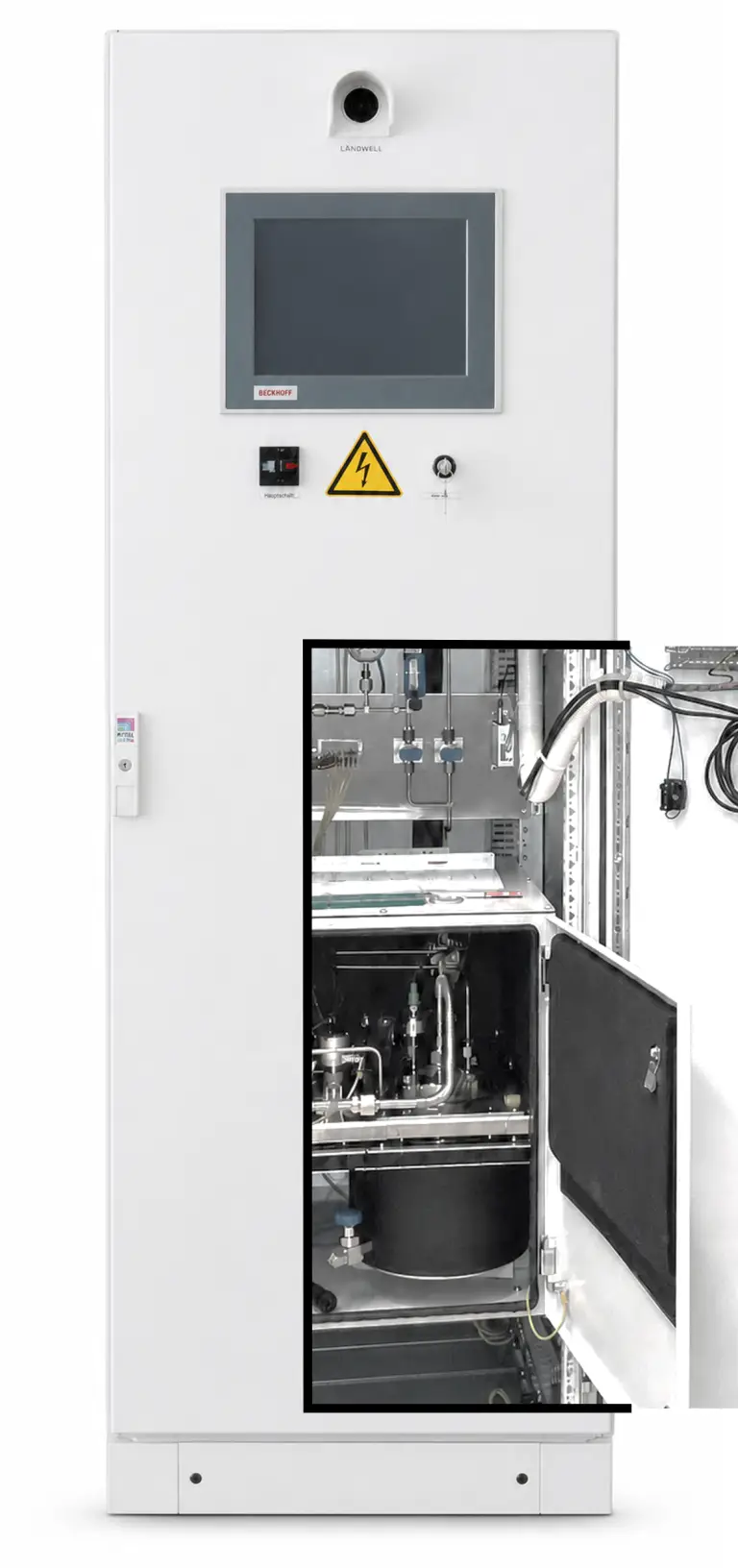
The simplest V107/V108 precursor vapourisation systems allow the vapour to be metered using an MFC from a heated vessel. All pipework is located within a heated area to prevent condensation.
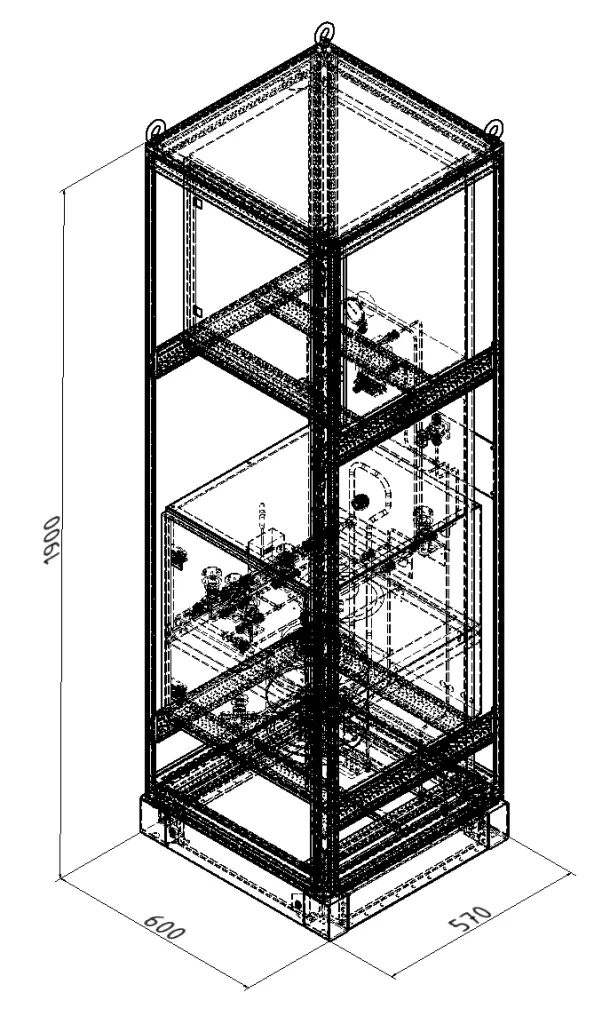
Technical specifications for the V107/V108 system with one precurser vaporizer and one process outlet
|
Feature
|
Data vaporizer system V107/V108 with one precursor
|
|---|---|
|
Dimensions H x W x D (mm)
|
1900; 600; 600
|
|
Delivery rate / throughput
|
typically 50 g/h to 2,000 g/h depending on the medium (continuous operation with refilling)
|
|
Evaporation temperature
|
Standard up to 55 °C, extended up to 90 °C, adaptable up to 140 °C Capacity
|
|
Capacity
|
3.5 l effective (5.2 l vessel)
|
|
Precursor chemicals (others available on request)
|
Silicon tetrachloride (SiCl₄), titanium(IV)-chloride (TiCl₄), trichlorosilane (HSiCl₃), hexamethyldisiloxane HMDSO (C₆H₁₈OSi₂), hexamethyldisilazane HMDS (C₆H₁₉NSi₂), chlorotrimethylsilane TMCS (C₃H₉ClSi), trimethylaluminium TMA (C₃H₉Al), diethylzinc DEZ (C₄H₁₀Zn), TEOS (C₈H₂₀O₄Si), titanium tetrachloride (TiCl₄), germanium- tetrachloride (GeCl₄), alcohols, water and much more.
|
|
Inert gas supply
|
100 Nl/h and 2–8 bar gauge pressure of nitrogen (N₂) or argon (purity 5.0 for chlorides 5.6), with inlet filter
|
|
Compressed air supply
|
5–8 bar g
|
|
Supply voltage
|
230 V / 16 A
|
|
Exhaust air for purging processes
|
approx. 5 l/min
|
|
Ex zones
|
No explosion-proof zones as the system is permanently technically leak-tight
|
|
Tightness
|
< 3E-8 mbarl/s helium, permanently technically leak-tight thanks to metallic face-seal fittings
|
|
Design
|
Enclosed cabinet with integrated, enclosed, heated evaporator compartment and independent, enclosed electrical cabinet.
|
|
Refilling
|
Connection for refilling during the process, refill trigger via scales, recommended refill system G504
|
Precursor vaporizer for a precursor and multiple process outlets 107/108-200
The ability to supply multiple consumers from a single evaporator makes it possible to build complex systems in a more compact manner and to utilise a shared evaporator source with the same medium. Overall, this reduces complexity and, consequently, costs and maintenance requirements, whilst increasing robustness.
- Direkte Precursor Verdampfen ohne Trägergas
- Mass flow-controlled: typically 50 g/h to 2000 g/h depending on the medium
- up to 10 process outputs possible
- Evaporator vessel 17 l, capacity 10 l, -1 to +5 bar
- Evaporator temperature up to 45 °C (temperatures up to 150 °C on request), monitored by a safety temperature limiter
- Applications e.g. HDMSO, HDMSN, TDMSO, TMA, DEZ, and many more
- Heated zone up to 50 °C (higher temperatures up to 140 °C on request)
- Supply to multiple consumers from a single evaporator
- Permanently technically leak-proof and ultra-high purity thanks to UHP components
- CPU-controlled with HMI and remote controllability via ADS, EtherCAT, Profinet by arrangement, Web HMI
- Automatische Nachfüllung im Prozess z.B. in Kombination mit unserem Precursor Vesorgungssystem G504
- Price on request, depending on configuration
- Delivery time from 12–16 weeks
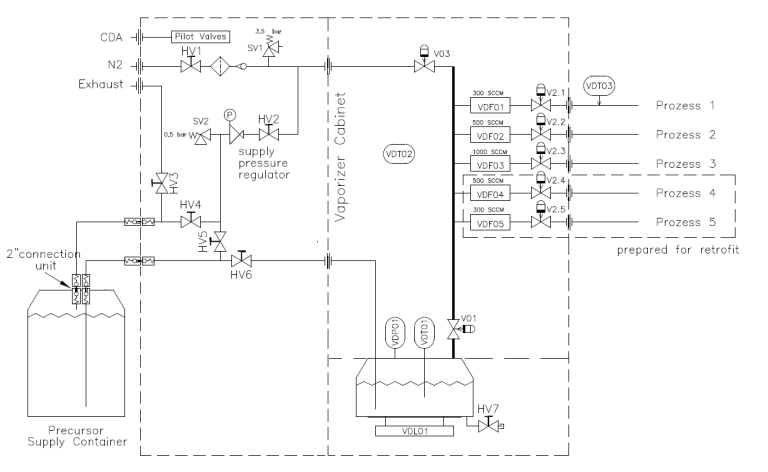
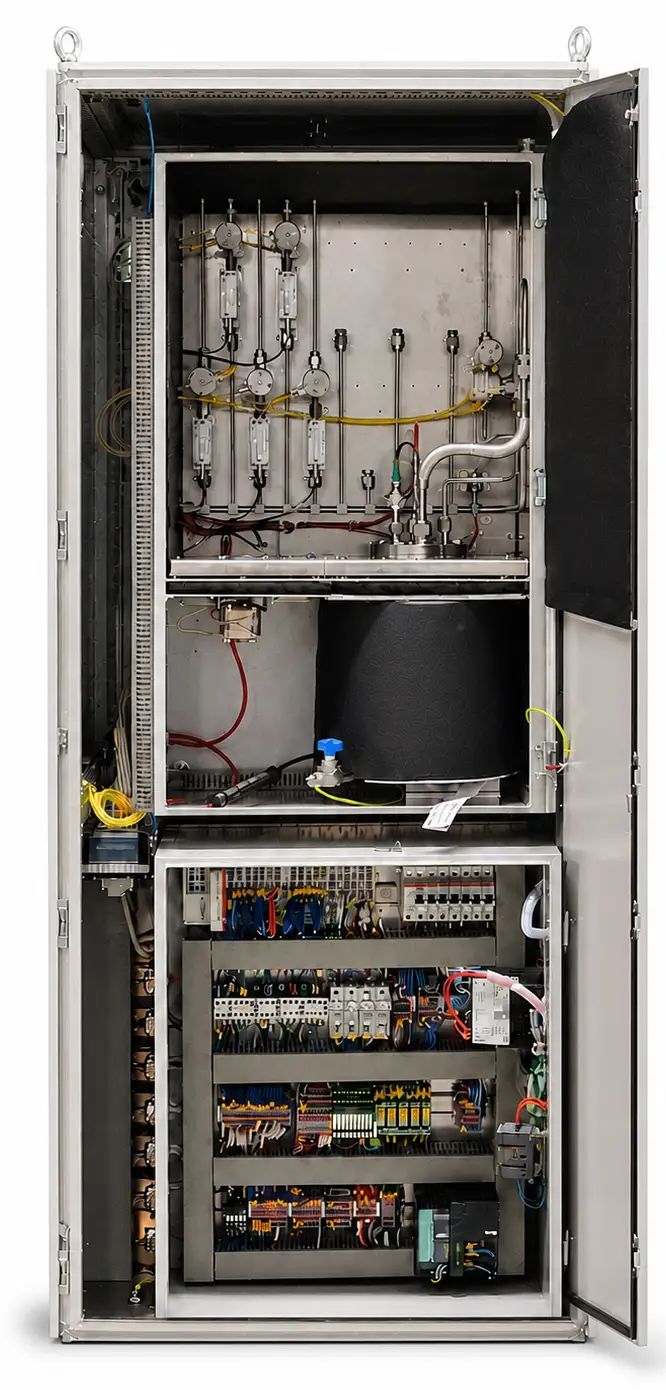
Evaporator system, V107 variant, with 3 independent process outputs for metal alkyl evaporators.
Technical specifications of the vaporizer system for one precursor and multiple process outlets
|
Feature
|
Data vaporizer system V107/V108 with one precursor
|
|---|---|
|
Dimensions H x W x D (mm)
|
1900; 600; 600
|
|
Delivery rate / throughput
|
typically 50 g/h to 2,000 g/h depending on the medium (continuous operation with refilling)
|
|
Evaporation temperature
|
Standard up to 55 °C, extended up to 90 °C, adaptable up to 140 °C Capacity
|
|
Capacity
|
3,5 l effektiv (Behälter 5,2 g);
|
|
Precursor chemicals (others available on request)
|
Silicon tetrachloride (SiCl₄), titanium(IV)-chloride (TiCl₄), trichlorosilane (HSiCl₃), hexamethyldisiloxane HMDSO (C₆H₁₈OSi₂), hexamethyldisilazane HMDS (C₆H₁₉NSi₂), chlorotrimethylsilane TMCS (C₃H₉ClSi), trimethylaluminium TMA (C₃H₉Al), diethylzinc DEZ (C₄H₁₀Zn), TEOS (C₈H₂₀O₄Si), titanium tetrachloride (TiCl₄), germanium- tetrachloride (GeCl₄), alcohols, water and much more.
|
|
Inert gas supply
|
100 Nl/h and 2–8 bar gauge pressure of nitrogen (N₂) or argon (purity 5.0 for chlorides 5.6), with inlet filter
|
|
Compressed air supply
|
5–8 bar g
|
|
Supply voltage
|
230 V / 16 A
|
|
Exhaust air for purging processes
|
approx. 5 l/min
|
|
Ex zones
|
No explosion-proof zones as the system is permanently technically leak-tight
|
|
Tightness
|
< 3E-8 mbarl/s helium, permanently technically leak-tight thanks to metallic face-seal fittings
|
|
Design
|
Enclosed cabinet with integrated, enclosed, heated evaporator compartment and independent, enclosed electrical cabinet.
|
|
Refilling
|
Connection for refilling during the process, refill trigger via scales, recommended refill system G504
|
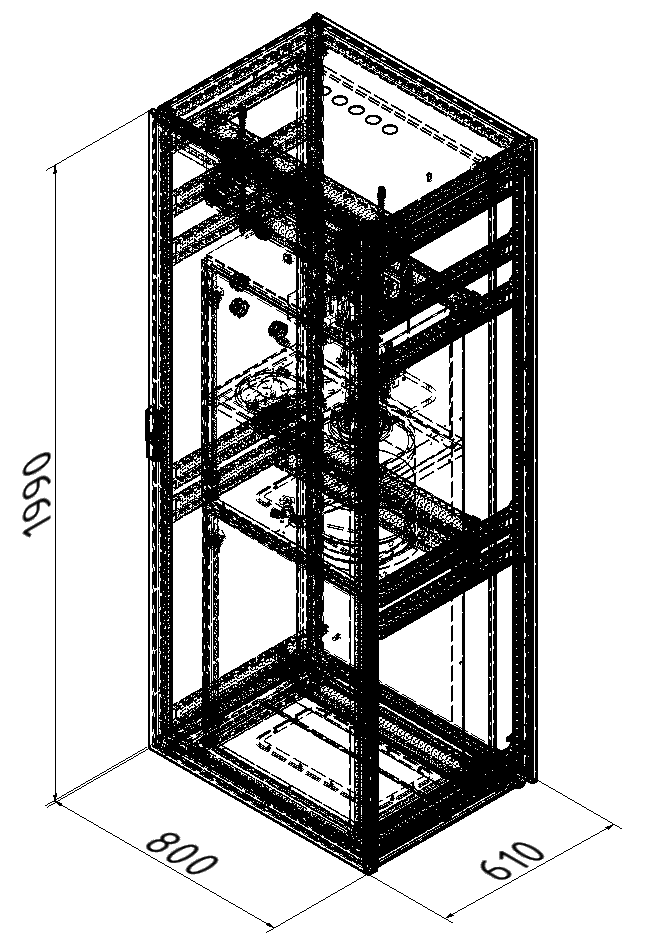
Platform V111 precursor vaporizer system
for two or more precursors to be mixed with process gases
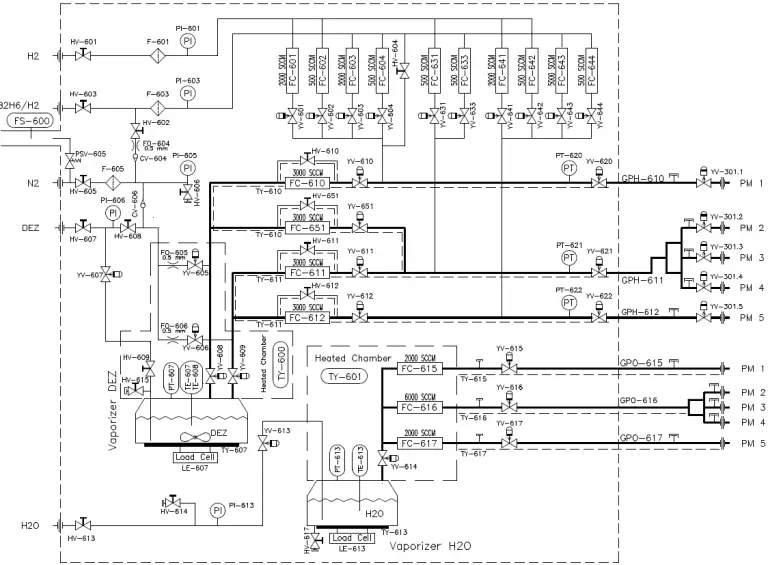
If a separation process involves the separation of several components that are present as liquids and are mixed with process gases or metered alternately, this platform allows for the full range of combinations, whilst also enabling multiple process outputs to be managed. The example shows a system with 2 evaporators and 6 process outputs, each of which meters independently. The platform has been built on numerous occasions and can be further adapted.
The system can also be adapted to different process gases through the use of multi-range and multi-gas MFCs.
By combining multiple components within a single system, it is possible to achieve a simply coordinated control system and to build a more compact system, which, taken together, reduces costs, maintenance requirements and integration efforts.
Internal connections improve reliability. MFC lines can be configured with redundancy to facilitate maintenance during continuous operation.
- Direct evaporation without a carrier gas
- Mass flow-controlled: typically 50 g/h to 2000 g/h depending on the medium
- Evaporator vessel 10 l, capacity 7 l, -1 to +5 bar
- Mixture of several process gases
- Heated fluidic chamber prevents condensation
- Permanently technically leak-proof
- Combination of multiple evaporators, multiple process gases and multiple process outlets
- Automatische Nachfüllung im Prozess z.B. in Kombination mit unserem Precursor Versorgungssystem G504
- Price on request
Technical specifications for the V111 system for two or more precursors
|
Feature
|
Daten System V111 für zwei oder mehr Precursor
|
|---|---|
Precursor vaporizer system by
Charge & Release from buffer tanks
As an alternative to dosing via an MFC, defined quantities of vapour can also be dispensed quickly using the ‘charge and release’ method from buffer vessels. This is particularly useful when defined quantities need to be dispensed within a short time. The ‘charge and release’ method is a viable solution for both small quantities dispensed quickly (e.g. ALD) and large quantities dispensed quickly.
A set pressure is built up in the buffer vessel from the evaporator. Valves close off the path to the evaporator. As required, other valves open the path to the process chamber. The vapour then flows from the buffer vessel into the chamber. The volume of the buffer vessel and the change in pressure during discharge allow the precursor vapour to be metered in a reproducible manner. The pressure build-up in the buffer vessel can be controlled, and processes can be further varied by diluting the vapour with a carrier gas.
This offers a wide range of control options for achieving precise and stable dosing processes. As the process operates entirely without MFCs, this system can also handle temperatures in excess of 200°C.
- Direct evaporation without a carrier gas
- Volume-controlled via buffer volume, filling pressure and discharge pressure (time)
- Process gases can be mixed in the buffer vessel
- No MFC required
- Temperatures above 200°C possible
- Evaporator vessels from 0.5 l to 30 l
- Buffer vessels from < 0.1 l up to 30 l (larger sizes available on request)
- Multiple evaporators per system and/or multiple buffer vessels connected to a single evaporator possible
- Automatische Nachfüllung im Prozess z.B. in Kombination mit unserem Precursor Versorungssystem G504
- Permanently technically leak-proof
- Prices on request, depending on configuration
- Delivery within 8 to 16 weeks, depending on the configuration level
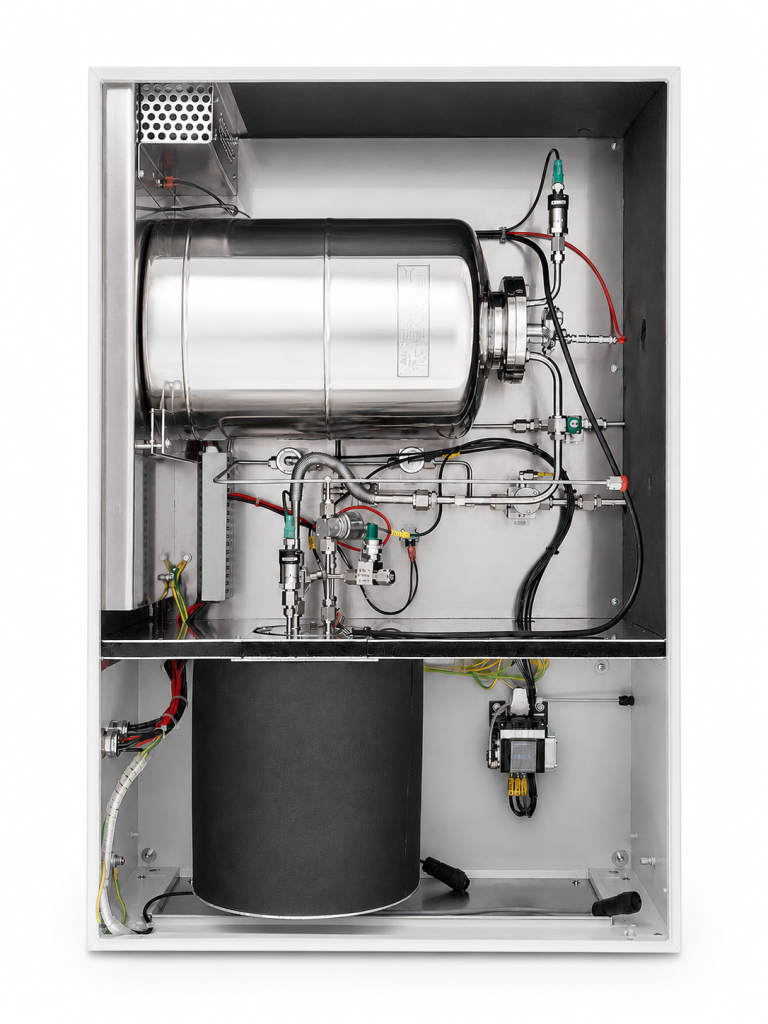
SIGA GmbH’s Charge & Release systems enable the controlled delivery of steam volumes and steam pulses without the need for an MFC.
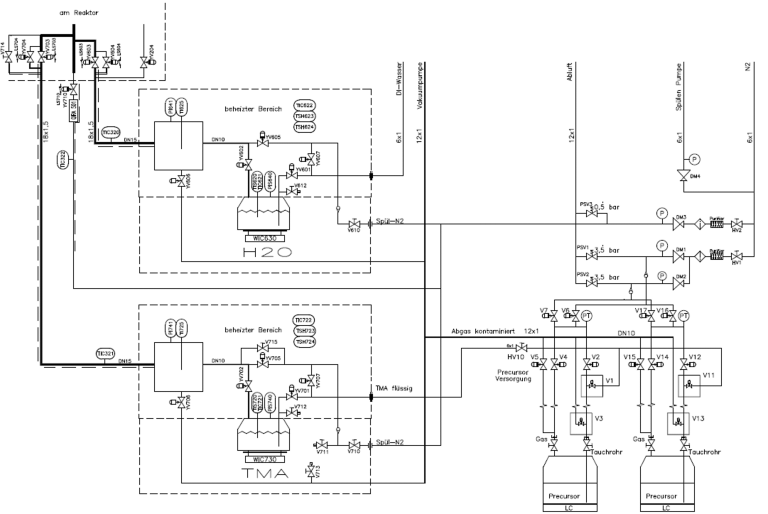
Technical specifications for Charge & Release precursor vaporizer
| Characteristic | Charge and Release system for 1 or 2 precursors and 1, 2, or more buffer vessels |
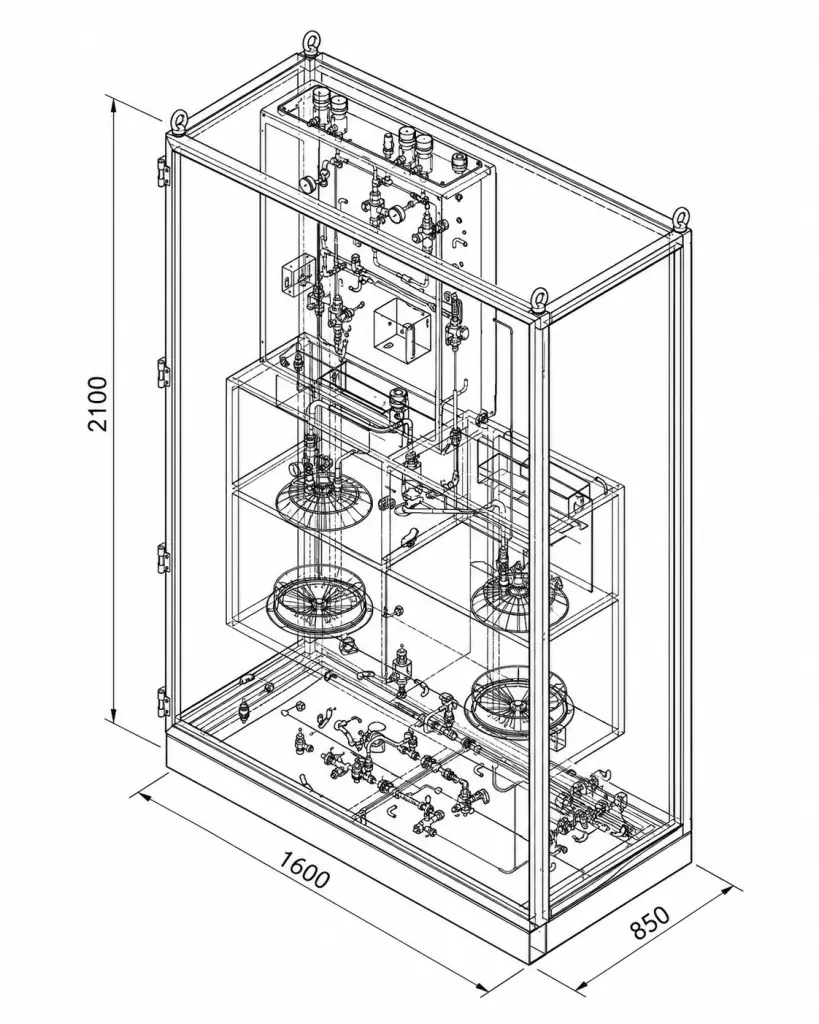
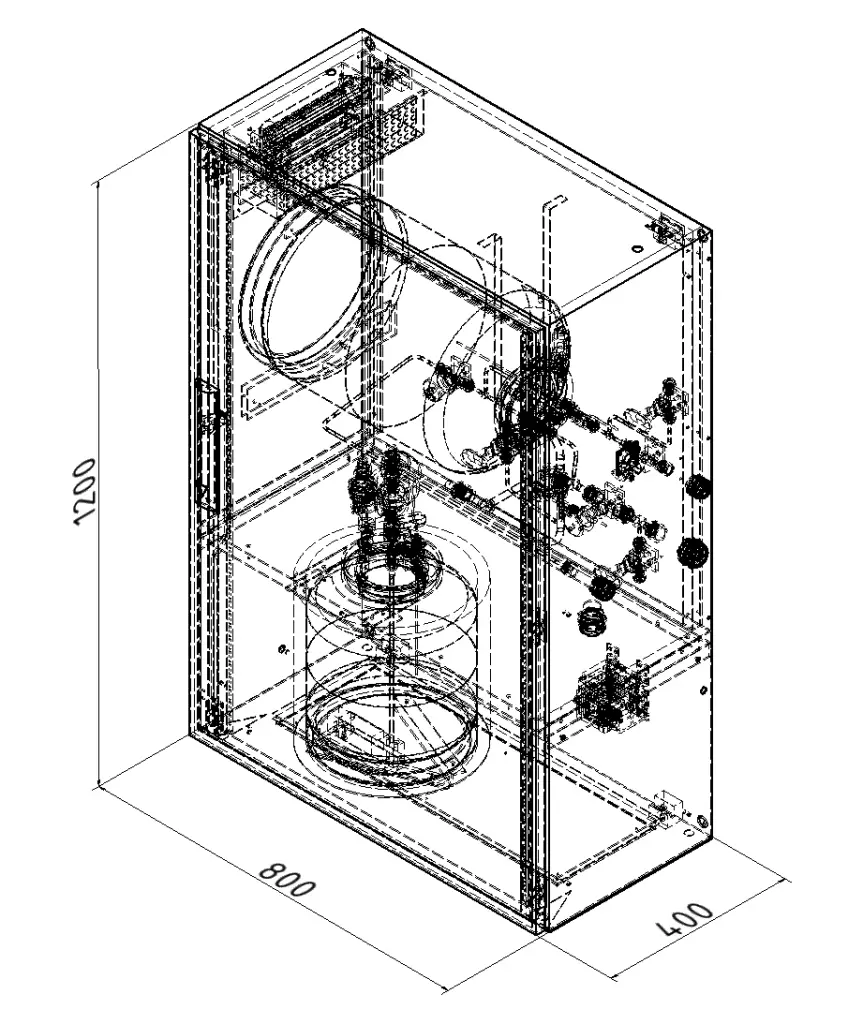
| Dimensions H x W x D (mm) | e.g. 2100 x 1600 x 850 / 1900 x 800 x 850 |
| Delivery rate / throughput | Typical process parameters: release of 1 mg to 5 g in 2 to 10 seconds; cycle time 10 s to 90 s. |
| Number of precursors | Up to 2 (more on request) |
| Number of process outlets | Bis 2 + X |
| Additional process gases | 1 + X e.g. nitrogen, H2, argon, silane |
| Evaporation temperature | Possible up to over 200°C (no MFC) |
| Evaporator capacity | 0.5 to 27 l possible |
| Buffer vessel capacity | 0.1 l to 30 l possible |
| Number of buffer vessels | 1 + X possible |
| Precursor chemicals (others available on request) | Silicon tetrachloride (SiCl₄), titanium(IV)-chloride (TiCl₄), trichlorosilane (HSiCl₃), hexamethyldisiloxane HMDSO (C₆H₁₈OSi₂), hexamethyldisilazane HMDS (C₆H₁₉NSi₂), chlorotrimethylsilane TMCS (C₃H₉ClSi), trimethylaluminium TMA (C₃H₉Al), diethylzinc DEZ (C₄H₁₀Zn), TEOS (C₈H₂₀O₄Si), titanium tetrachloride (TiCl₄), germanium- tetrachloride (GeCl₄), alcohols, water and much more. |
| Inert gas supply | 100 Nl/h and 2–8 bar gauge pressure of nitrogen (N₂) or argon (purity 5.0 for chlorides 5.6), with inlet filter |
| Compressed air supply | 5–8 bar g |
| Supply voltage | 230 V / 16 A |
| Exhaust air for purging processes | Approx. 5 l/min |
| Ex zones | No explosion-proof zones as the system is permanently technically leak-tight |
| Leak tightness | < 3E-8 mbarl/s helium, permanently technically leak-tight thanks to metallic face-seal fittings |
| Safety | Safety temperature limiter, emergency stop function, spring-return valves in the event of a power failure or emergency stop, ventilation options, gas sensors |
| Design | Enclosed cabinet with a heated evaporator compartment and a heated buffer zone |
| Refilling | Connection for refilling during the process, refill trigger via scales, recommended refill system G504 |
| Control | Control via Beckhoff IPC via a local panel and remote interface. Configurable routines for: steam discharge, purging procedures, refilling process, manual mode for maintenance work |
| Control interface | Remote HMI, Secure ADS, Profinet, RS485 supported. Triggering routines, reading sensor data, setting configuration values |
Bubbler type precursor vaporizer
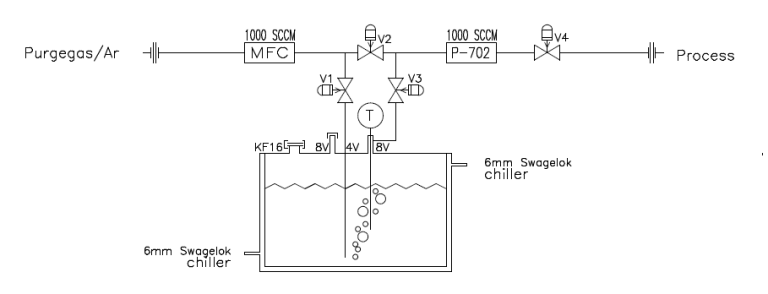
Precursor vaporization systems based on the bubbler principle utilize a carrier gas that is passed through the heated vaporization tank and exits the bubbler together with the precursor vapor.
They are particularly suitable for processes in which sufficient process pressure cannot be generated by the precursor vapor alone.
Am Eingang des Verdampfers wird der Fluss des Trägergases kontrolliert, während am Ausgang der Druck, sowie im Verdampfer die Temperatur gemessen wird. Als kostengünstige alternative zu trägergasfreien Verdampfern ist bei Bubbler-Verdampfersystemen eine geringe Verunreinigung des Precursers, durch das Trägergas hinzunehmen. Der Precursor enthält Rückstände des Trägergases, da der Precursor kontinuierlich mit dem Trägergas durchströmt wird.
Thanks to its design, the bubbler offers a highly cost-effective overall system for processes where moderate precision is sufficient.
To achieve lower loading rates and enable vaporization at temperatures below ambient, a secondary heat exchanger with a cooling unit can be employed.
Our basic system comprises a bubbler equipped with a carrier gas mass flow controller (MFC) at the inlet and a pressure control unit at the outlet.
We would be happy to configure your system to meet your specific requirements.
- Evaporation using a carrier gas
- Indirect mass flow control
- Pressure stabilization via carrier gas for atmospheric processes and low evaporation temperatures
- Simple design
- Permanently technically leak-proof
- Available in standard pack sizes such as DOCK 10, 20, 50 or 100
- Automatic in-process refilling, ideal when used in combination with our G504 precursor refill system
- Manufactured from S316L / 1.4404, suitable for all common precursors with dry carrier gases
- Price on request, depending on configuration
- Typical lead time: 8 to 16 weeks after order confirmation
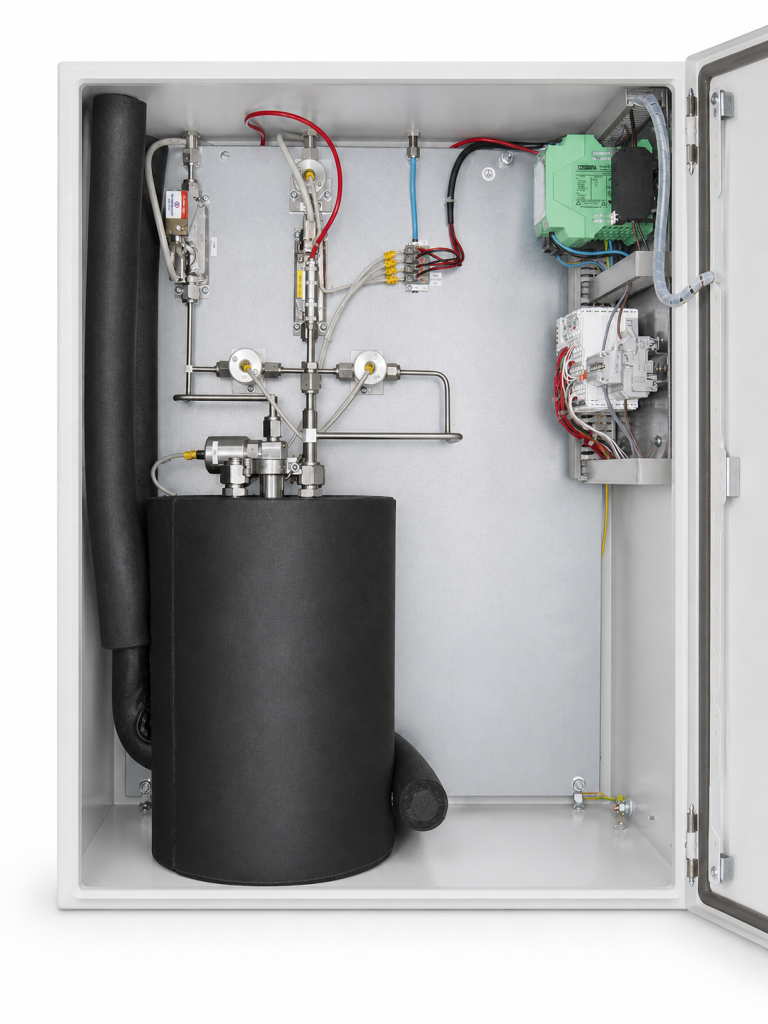
Bubbler Precursor Verdampfersysteme der SIGA GmbH
Technical specifications for bubbler precursor vaporizer system for one or more precursors
| Characteristic | Bubbler type precursor vaporizer system |
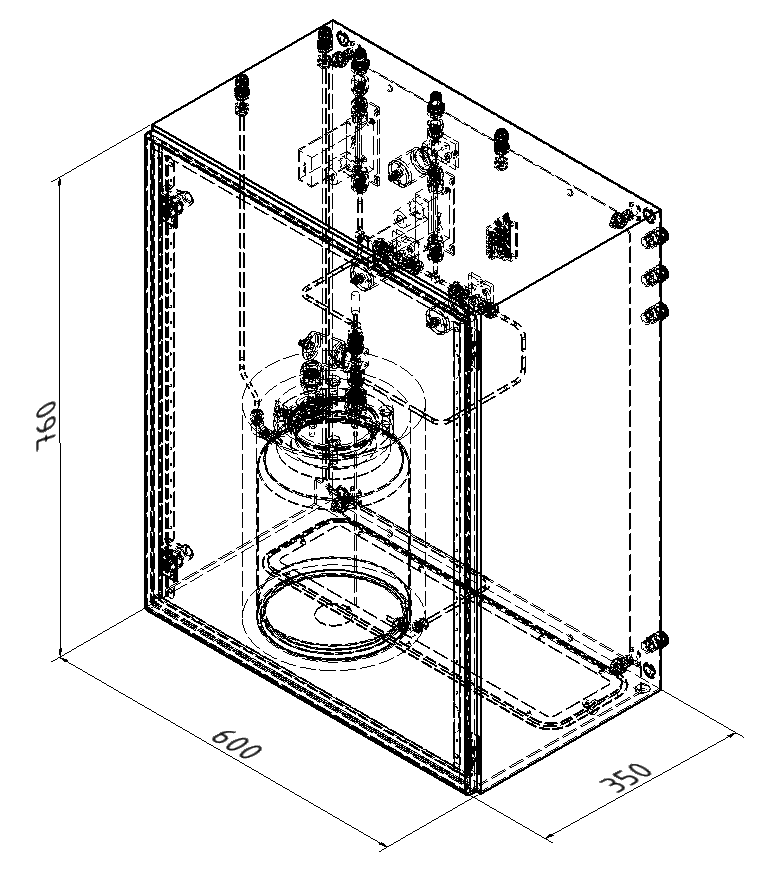
| Dimensions H x W x D (mm) | From 350 x 600 x 760 |
| Delivery rate / throughput | Typically up to 20 g/h; other rates depending on precursor available upon request. |
| Number of precursors | 1 |
| Number of process outlets | 1 with branching |
| Carrier gas | Typical N2 5.6, up to 2000 sccm |
| Evaporation temperature | Bis 70°C, höhere Temperaturen auf Anfrage |
| Evaporator capacity | Capacities from 0.5 to 27 L possible; suitable for standard containers such as DOCK10, 20, 50, or 100 |
| Precursor chemicals (others available on request) | Silicon tetrachloride (SiCl₄), titanium(IV)-chloride (TiCl₄), trichlorosilane (HSiCl₃), hexamethyldisiloxane HMDSO (C₆H₁₈OSi₂), hexamethyldisilazane HMDS (C₆H₁₉NSi₂), chlorotrimethylsilane TMCS (C₃H₉ClSi), trimethylaluminium TMA (C₃H₉Al), diethylzinc DEZ (C₄H₁₀Zn), TEOS (C₈H₂₀O₄Si), titanium tetrachloride (TiCl₄), germanium- tetrachloride (GeCl₄), alcohols, water and much more. |
| Inert gas supply | 100 Nl/h and 2–8 bar gauge pressure of nitrogen (N₂) or argon (purity 5.0 for chlorides 5.6), with inlet filter |
| Compressed air supply | 5–8 bar g |
| Supply voltage | 230 V / 16 A |
| Exhaust air for purging processes | Approx. 5 l/min |
| Ex zones | No explosion-proof zones as the system is permanently technically leak-tight |
| Leak tightness | < 3E-8 mbarl/s helium, permanently technically leak-tight thanks to metallic face-seal fittings |
| Safety | Safety temperature limiter, emergency stop function, spring-return valves in the event of a power failure or emergency stop, ventilation options, gas sensors |
| Design | Enclosed cabinet with a heated evaporator |
| Refilling | Connection for refilling during the process, refill trigger via scales, recommended refill system G504 |
| Control | Control via Beckhoff IPC via a local panel and remote interface. Configurable routines for: steam discharge, purging procedures, refilling process, manual mode for maintenance work |
| Control interface | Remote HMI, Secure ADS, Profinet, RS485 supported. Triggering routines, reading sensor data, setting configuration values |
Liquid dosing followed by evaporation
(direct evaporation)
Dosing using a carrier gas is the more precise alternative to using so-called DLI (Direct Liquid Injection) systems or CEM (Controlled Evaporation and Mixing) systems.
In this process, both the mass flow rate of the carrier gas and that of the precursor are controlled. The two media are then combined. The liquid is vaporised and transported together with the carrier gas. Various systems exist, some of which utilise the heated carrier gas stream itself to further vaporise any aerosol that has formed.
Thanks to precise fluid metering, DLI systems ensure the highest levels of accuracy in both the quantity and composition of the process gases supplied.
SIGA GmbH incorporates components from renowned manufacturers into its systems as required. Drawing on our experience and independence, we also combine various precursors and processes within a single system to meet specific customer requirements.
Example: 4-line mixing system
– Silane from a gas cabinet
– HMDSO from a DLI system without carrier gas
– TTIP from a DLI system with carrier gas
– TMA from a direct evaporator (baking)
- Use of established DLI (Direct Liquid Injection) systems from established manufacturers
- For liquids that are difficult to vaporise or at low temperatures
- Experimental and production systems
- With (e.g. TTIP) and without a carrier gas (e.g. water)
- Permanently technically leak-proof
- Typical lead time: 12 to 20 weeks after order confirmation
- Price on request, depending on configuration
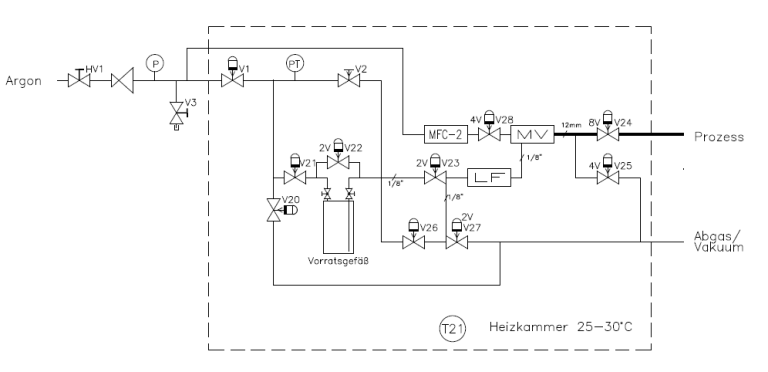
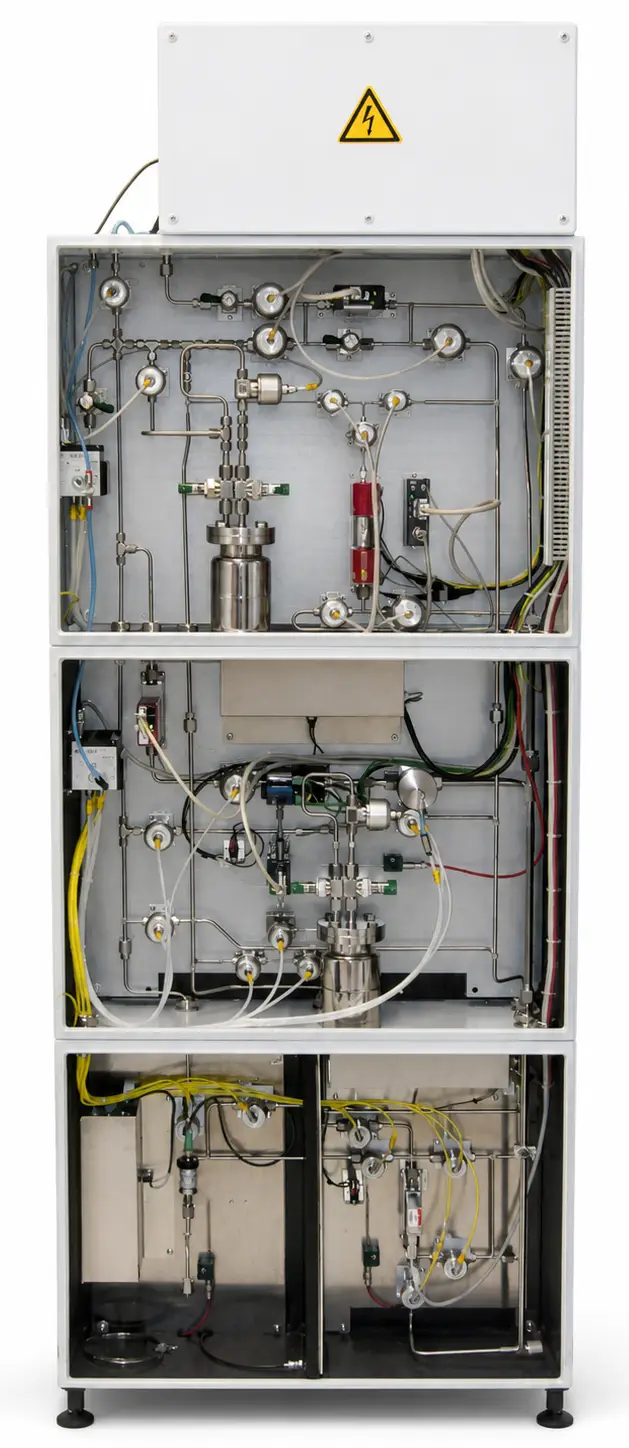
An evaporator and gas mixing system that combines both direct evaporators and two DLI systems
Technical specifications for liquid dosing followed by evaporation
| Characteristic | Example combination for liquid dosing followed by evaporation |
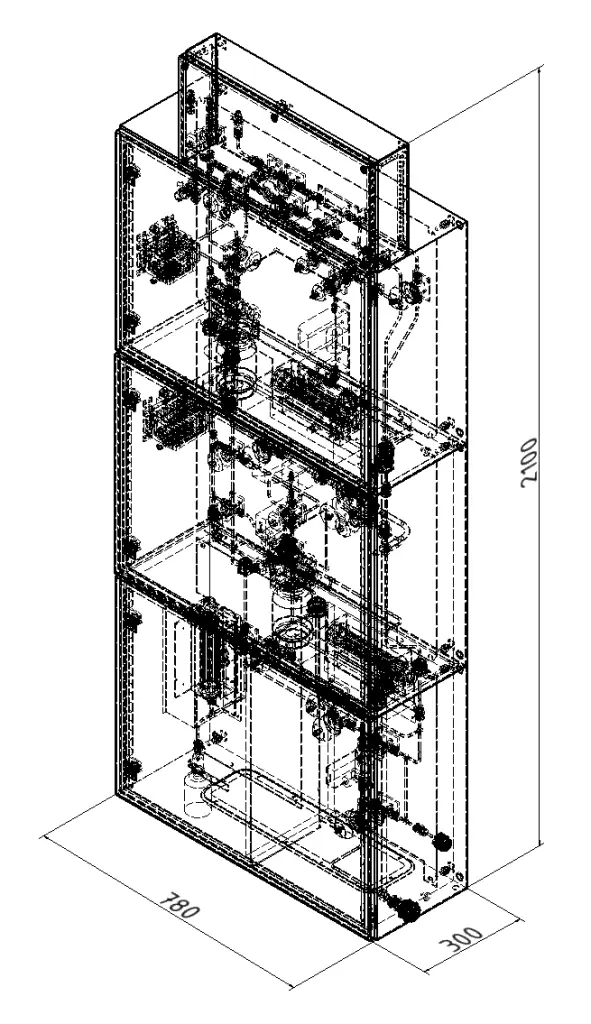
| Dimensions H x W x D (mm) | 2100 x 780 x 300 |
| Delivery rate / throughput | 300 sccm HMDSO, 2.5 g/min TTIP, 100 SCCM TMA, 120 sccm silane |
| Number of precursors | 3 |
| Number of process outlets | 1 |
| Carrier gas | Max. 4000 SCCM Argon |
| Evaporation temperature | 50°C |
| Evaporator capacity | 0.7 l each |
| Precursor chemicals (others available on request) | Trimethylaluminum TMA (C3H9Al), hexamethyldisiloxane HMDSO (C6H18OSi2), hexamethyldisilazane HMDS (C6H19NSi2), TTIP tetraisopropyl titanate (C12H28O4Ti), others possible |
| Inert gas supply | 100 Nl/h and 2–8 bar g nitrogen (N2) or argon 5.6/6.0 |
| Compressed air supply | 5–8 bar g |
| Supply voltage | 230 V / 16 A |
| Exhaust air for purging processes | Approx. 5 l/min |
| Ex zones | No hazardous zones, as the system is permanently technically sealed and container changes are performed without opening the system. |
| Leak tightness | < 3E-8 mbarl/s helium, permanently technically leak-tight thanks to metallic face-seal fittings |
| Safety | Safety temperature limiter, emergency stop function, valves closing via spring force upon loss of power or emergency stop, ventilation options, smoke sensor for sealant component |
| Design | Enclosed cabinet with heated evaporator sections in 4 zones |
| Refilling | Connection for refilling during the process, refill trigger via scales, recommended refill system G504 |
| Control | Control via Beckhoff IPC via a local panel and remote interface. Configurable routines for: steam discharge, purging procedures, refilling process, manual mode for maintenance work |
| Control interface | Remote HMI, Secure ADS, Profinet, RS485 supported. Triggering routines, reading sensor data, setting configuration values |
Customised precursor vaporizer systems
We build your customized evaporator solution based on our modular system to meet your specific requirements. We are accustomed to—and look forward to—integrating new components and solutions to provide you with an optimal, efficient result, whether for a series-produced system or a one-off project.
- Application-oriented and tailor-made
- Gain a competitive edge with the ideal system for your process
- Rapid implementation thanks to a proven modular system
- Hardware, software and security from a single source
- Proven components based on 30 years’ experience
- Integration of new components from the market using an established supplier network
- Any combination of different evaporation strategies
- We would be happy to provide you with a quotation
Your process, your system!
Precursor vaporizer
Precursor vaporizer systems are used to evaporate and meter liquid precursors that are fed into a CVD, PECVD or ALD deposition process as a gas phase. The evaporation and metering of the precursors takes place either via a system without a carrier gas, the direct evaporator or using a carrier gas.
Typical applications include the evaporation and metering of water, solvents, silanes, chlorides and metal alkyls such as SiCl₄, TiCl₄, SiHCl₃, HMDSO, DEZ, TMA or TEOS. Naturally, all other precursors can also be used; we are happy to assess the feasibility of specific precursors and operating ranges. The evaporation systems are frequently used in CVD, PECVD or ALD processes for gas-phase deposition, usually at reduced process pressures (LPCVD) or with plasma assistance (PECVD). Applications also arise at atmospheric process pressures, such as in flame hydrolysis (FHD) or plasma spraying processes.
Among the distinctive features of the evaporation systems are, in addition to the ability to evaporate without a carrier gas, the ability to supply multiple consumers from a single evaporator. It is possible both to supply several process chambers simultaneously and to feed precursor vapour into the process chamber at various points.
The ability to supply multiple consumers from a single evaporator reduces the number of components, control elements and the space required for installation compared with other designs. Overall, this helps to reduce the costs of maintenance, plant engineering and system integration. Another option is to integrate two evaporators into a single system with a shared control system.
Precursor vaporizer Direct evaporation systems (baking)
The precursor is fed into a stainless steel tank, the evaporator, where it is regulated to the desired evaporation temperature. The resulting vapour phase is regulated to the set flow rate via a mass flow controller (MFC) and fed into the process. Additional gas streams can be adjusted and fed into the process, irrespective of the required amount of precursor.
Precursor Vaporizer - Bubbler type
Bubbler systems, on the other hand, utilise a carrier gas flow to deliver the precursor by passing the carrier gas through a reservoir vessel. These systems are simple in design and, when combined with standard containers (e.g. DOCK), provide a cost-effective, reproducible solution within a range of accuracy that is sufficient for many processes. The range of accuracy can be improved by using additional sensors. For example, a humidity sensor can be used in conjunction with a water evaporator to measure the humidity downstream of the bubbler. The required humidity level can be achieved by mixing in dry nitrogen (see AKF humidification stations).
Processes in which accuracy is of the utmost importance should, however, favour direct evaporator systems.
Precursor vaporizer DLI systems (Direct Liquid Injection)
DLI systems represent another variant. Here, the precursor is evaporated in a metered manner using a liquid flow controller and then mixed with the carrier gas. To enable evaporation at the level of the carrier gas pressure, the gas flow itself is utilised for aerosol formation and evaporation. Process temperatures range from room temperature to well over several hundred degrees Celsius. Owing to the independent flow control of the precursor and carrier gas, these systems achieve a high degree of accuracy in absolute dosing, similar to direct evaporators, but can reach higher maximum pressures.
Such equipment is available on the market from various manufacturers, and we at SIGA GmbH integrate it into our systems as required. However, this complex equipment makes the systems more expensive and must be operated using high-quality media, as replacing the components is considerably more costly than replacing a simple MFC.
Precursor vaporizer Charge & Release systems
Charge & Release systems dispense without the use of MFCs, based on pressure and volume in a buffer vessel. The buffer vessel is filled with vapour from the evaporator up to a maximum of the current evaporator pressure and then emptied into the process. The dispensed volume can be controlled via pressure differential, temperature and volume. These systems do not require MFCs and allow for the dispensing of small vapour volumes, as required in ALD processes, as well as the short-term delivery of high flow rates. By adjusting the pressure and temperature, as well as using buffer vessels and outlet orifices, reproducible processes can be set up across a wide range of parameters. Furthermore, the systems operate without being limited, for example, by the temperature resistance of MFCs.
Precursor vaporizer - SIGA GmbH
Siga GmbH is capable of designing and installing all types of evaporator systems. Furthermore, where appropriate, we also design combinations of different operating principles in order to achieve the optimal system or come as close to it as possible.
Our evaporator systems feature metal seals; elastomers are not used within the evaporator system. This fulfils a key requirement for safe operation. The system is designed on a bespoke basis according to the specific requirements of each application. The operating temperature of the evaporator is determined by the process pressure and the vapour pressure of the selected precursor and can, for example, range up to 80°C or up to 140°C.
Pressure and temperature within the evaporator are monitored; in the event of overpressure or overtemperature, the evaporator’s heating is switched off. All components carrying precursor vapour are heated. The system is housed in its own enclosure. Pipe trace heating for the vapour line to the process chamber is also fitted if the line pressure so requires.
The pipework and all components in contact with precursor vapour are made of stainless steel, material no. 1.4404, equivalent to SS316L. Face-seal fittings are used, e.g. Swagelok VCR. The utmost importance is attached to ensuring a leak-tight design. Fixed pipe joints are welded using orbital welding under an inert gas atmosphere.
The evaporator can be automatically refilled whilst the process is running. A precursor refill system is used to refill the evaporator. The precursor is stored in a storage vessel and, with the aid of a gas reservoir, is forced out through an immersion tube and fed into the evaporator.
The evaporator is controlled and monitored – including temperature control and automatic refilling – by the evaporator control system via a programmable logic controller (PLC) with a touch-screen for visualisation and operation. All functions are regulated by this control system. The setpoint for the MFCs and the selection of the desired gas path are determined by the higher-level control system of the coating plant. Communication is via a Profibus DP or another serial interface. The details of the control system, such as the type of operation with options for manual intervention and communication with the higher-level control system, are adapted to the requirements of the process.
The evaporator systems are installed in suitable sheet steel enclosures or in standard control cabinets. The control unit and evaporator can be integrated into a single cabinet or installed in two separate cabinets. The configuration can be adapted so that the system can be integrated into the coating plant as effectively as possible and tailored to the requirements at the installation site.
The integrated PLC control system with touch screen enables automatic regulation of temperature, pressure and level. Continuous replenishment whilst the process is running can be achieved via an external supply system with a gas reservoir – reliably and user-friendly. Communication with the main plant takes place via Profinet, Ethernet with SecureADS, RS485 or other industry standards.
In addition to passive safety elements and enclosed safety components such as safety temperature switches or safety threshold switches, a safety PLC (e.g. TwinSAF) is also used where necessary; this routes safety-critical functions and can interrupt or activate them independently of the actual control programme, based on a logic table derived from a safety assessment.
Safety functions such as shutdown in the event of overpressure or overtemperature are an integral part of the control system. The system can be configured modularly: as a stand-alone solution or as a multi-precursor system with central control. Enclosures made of sheet steel or in explosion-proof designs are available, as is integration into existing control cabinets.
- Metallic seals and leak-proof: No elastomers in the steam path; orbitally welded stainless steel components (SS316L).
- Heated vapour path: All pipes carrying precursor vapour, including pipe trace heating up to the process chamber, are heated – no risk of condensation.
- Reduced installation effort: Supplying multiple process points from a single evaporator saves on components, valves, control systems and space.

Dr. Ing. Tobias Metz
Managing Director and Sales
You are welcome to contact me directly regarding your vaporizer system.