
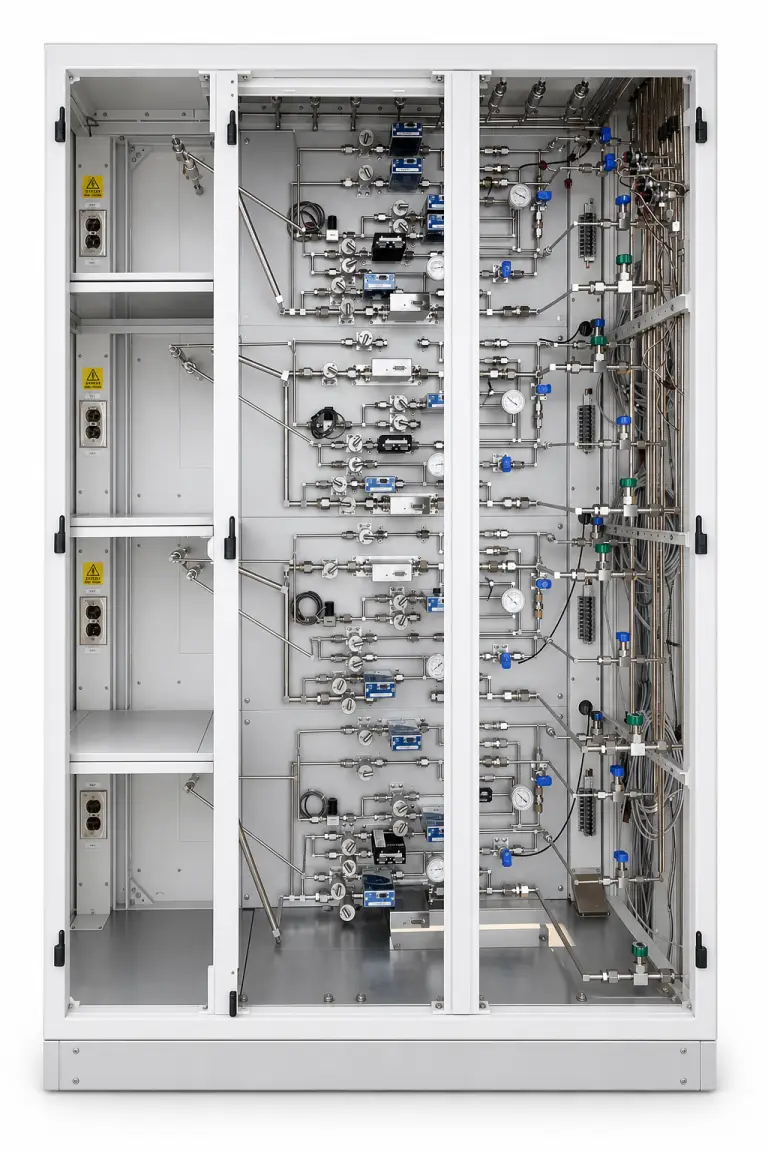
Gas dosing and gas mixing systems
SIGA gas mixing systems enable the precise mixing of technical gases for industrial processes—offering flexible configuration, exact control, and reliable process operation.
Whether for shielding gas, reference mixtures, or process gas, our systems deliver precise and flexible mixing—ranging from simple two-gas systems to complex eight-component installations.
Gas dosing and mixing systems are available in various configurations within our standard platforms and custom solutions. This allows us to draw on our expertise and experience to meet your specific requirements and provide tailored solutions.
We develop the appropriate safety and monitoring concept to address overpressure or the leakage of flammable, toxic, or corrosive gases.
- MFC-controlled mixing processes
- For 2 to n gases
- Continuously adjustable mixing ratios
- Dedicated HMI system with touch panel
- Connectivity via all standard interfaces (Profinet, ADS, RS485, etc.)
- Direct signal transmission via terminals
- Permanently technically leak-proof
- Safety features as required
- Safety PLC for advanced safety functions
Gas Dosing and Mixing
We integrate all essential components for your gas dosing system—including MFCs, valves, mixers, Venturis, pressure reducers, and inlet pressure regulators.
Auf Ihre Bedürfnisse zugeschnitten nach adäquaten Berechnungen zu erforderlichen und erreichbarer Performance. Gasmischanlagen nach Maß.
- Application-oriented and tailor-made
- VCR technology, orbital welding, clamping ring
- Permanently technically leak-proof
- Tailored to your requirements
- Cost-effective thanks to lean processes
- 8 weeks delivery time
- Compliance with relevant national and international legal and industry standards (TRGS, EIGA, Pressure Equipment Directive, etc.)
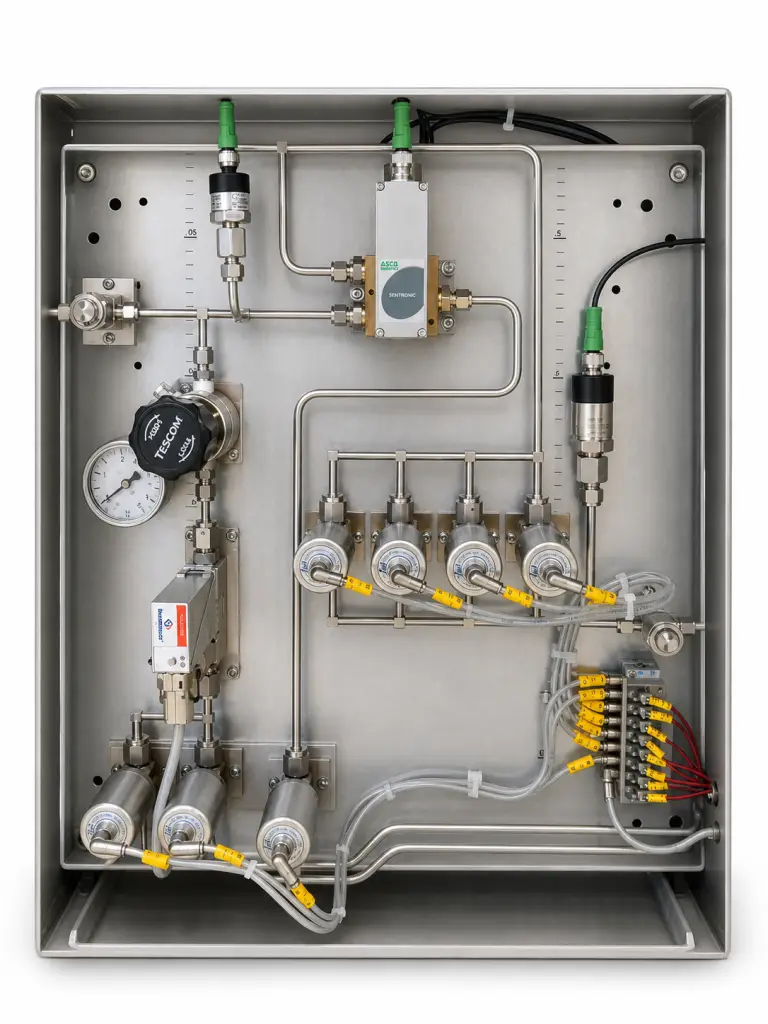
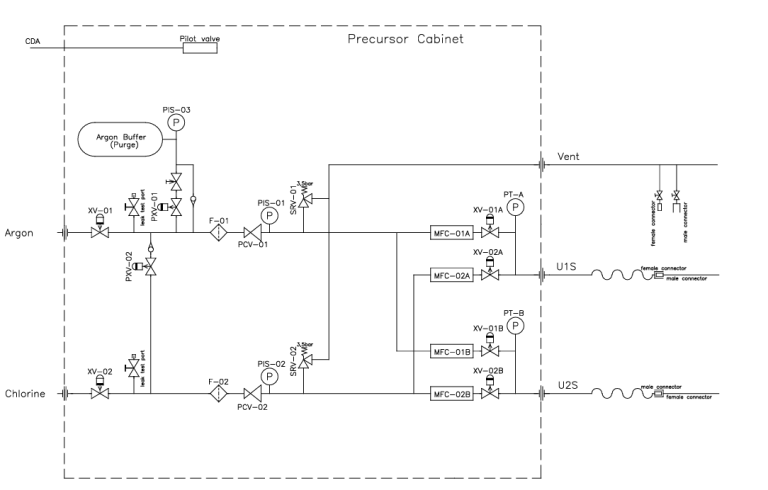
Gasmischanlage zur Dosierung von zwei Gasen in eine Schmelze.
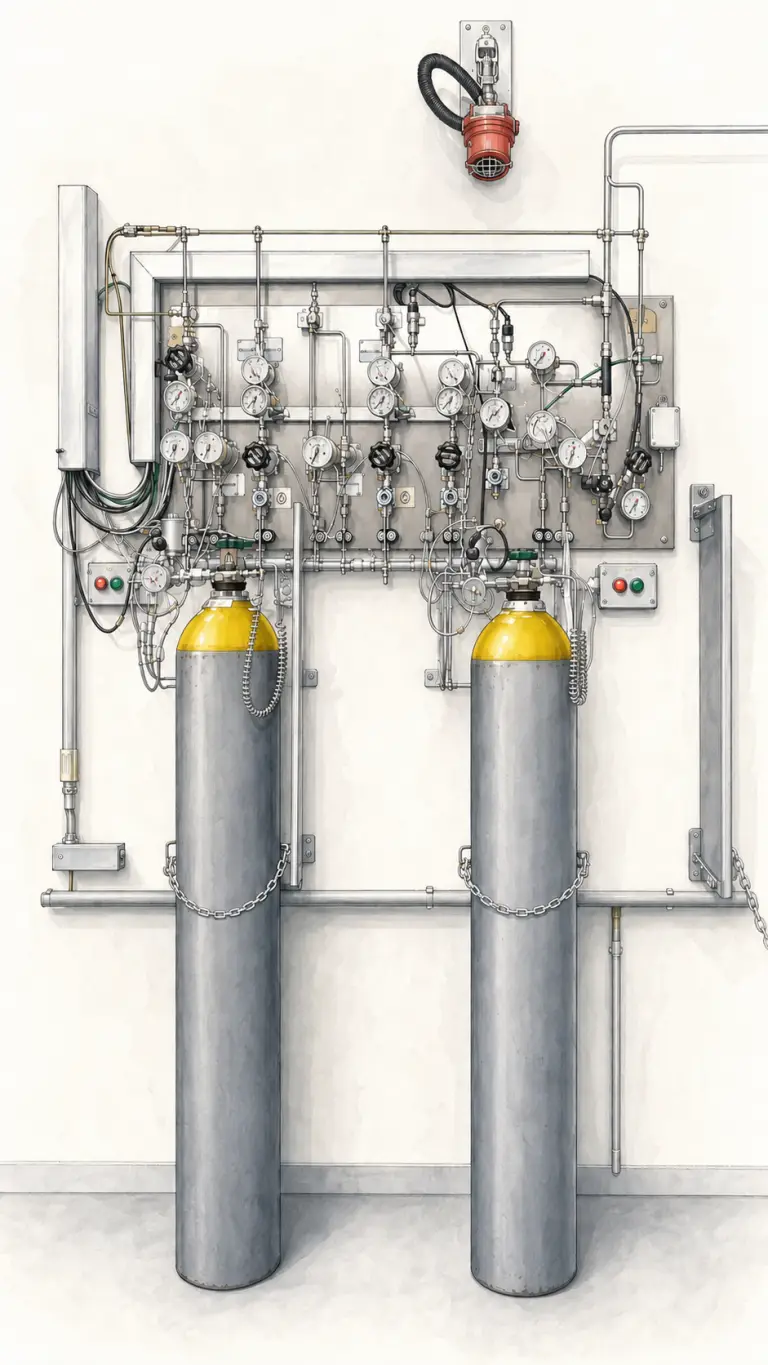
Gas storage facilities and delivery stations
If required, we also construct gas panels for the supply of critical gases in compliance with relevant regulations such as TRGS and EIGA.
Storage facilities for hazardous gases like silane or hydrogen, in particular, require a rigorous safety architecture—but with that in place, the risks can be effectively managed.
We implement your gas storage facility with great seriousness—though without fear—so that you can work with peace of mind.
- Uninterrupted supply via automatic cylinder switchover
- Silane, hydrogen, oxygen, and more
- Safety concept compliant with EIGA and TRGS standards, with certification by an authorized inspection body (ZÜS)
- Installation in a ventilated cabinet or secure outdoor area
- Purging routines
- Cylinder change routines
- Inerting
- Flame monitors, ultrasonic sensors, and gas detection systems as required
- Robust components from renowned manufacturers
- Permanently technically leak-proof
- UHP components; permanently leak-tight thanks to face seal or compression fitting technology
- Price upon request and subject to system design
- 8 weeks delivery time
Technical description
Gas mixing systems come in a wide variety of configurations. They may take the form of a gas mixer for two gases—designed to meter shielding gas, forming gas, synthetic air, or lean air—or a gas dosing system that blends up to eight gases to create a reference mixture for calibrating gas sensors or simulating environmental conditions to test the impact of harmful gases on products. Alternatively, they may serve to supply the required gas mixture to a deposition process. In all cases, the mixing ratio is continuously adjustable.
The core components of these gas dosing systems are the MFCs—electronic mass flow meters and controllers. The physical parameter measured is the heat transfer from the gas flowing past the sensors. The measurement accounts for the number of gas molecules passing the sensor, in addition to the gas's inherent physical properties, thereby yielding a true mass flow measurement. Readings are displayed in liters per minute, normalized to standard conditions (0°C and 1,013 hPa). Conversion factors can be applied when working with different gases.
Key components of gas dosing and mixing systems
Other important components of the gas mixing system include the valves, which may feature diaphragm or bellows seals. Actuation is typically pneumatic—either spring-to-close or spring-to-open—though inlet and purge valves are operated manually. Solenoid valves are also used as an alternative. The systems are complemented by pressure reducers, pressure gauges, check valves, and so forth. Additional components are selected based on specific application requirements.
Stainless steel piping is used, featuring a surface roughness of 0.4 µm and material grade 1.4404 or 1.4435 (equivalent to SS316/316L).
Pipe connections can be welded using automatic orbital welding under inert gas. For detachable connections, compression fittings are used, or—to facilitate component removal—face-seal fittings (such as VCR fittings with silver-plated stainless steel gaskets) are employed.
Installation of a gas dosing or mixing system
The gas mixing system is installed within a powder-coated sheet steel enclosure. Alternatively, the unit may simply be mounted on a mounting plate for direct integration into the customer's system.
A dedicated programmable controller with an operator panel can be used to control the gas mixing systems (or gas dosing systems). As an alternative, signals can be routed to a bus node, enabling communication with the system controller via Profibus DP or another serial interface. Another option is to connect the signals directly to the system controller via a terminal block.
- Dedicated HMI system with touch panel
- Connection via PROFIBUS DP or serial interface
- Direct signal transmission via terminals

Dr. Ing. Tobias Metz
Managing Director and Sales
Request your gas dosage or mixing system directly with me