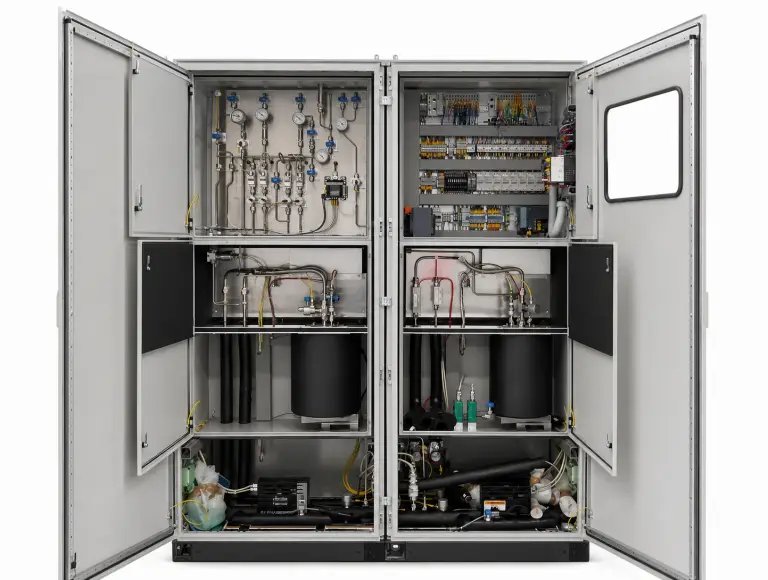
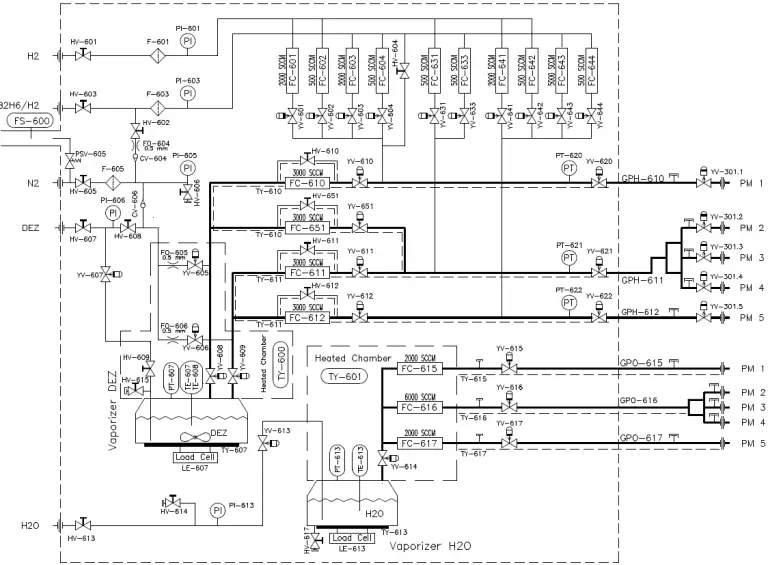
Precursor Verdampfer dienen der Verdampfung und Dosierung flüssiger Precursor die einem CVD, PECVD oder ALD Abscheideprozess als Gasphase zugeführt werden. Die Precursor Verdampfung und Dosierung erfolgt entweder über ein System ohne Trägergas, dem Direktverdampfer oder unter Verwendung eines Trägergases.
Typische Anwendungen sind die Verdampfung und Dosierung von Wasser, Lösungsmitteln, Silanen, Chloriden und Metallalkylen wie SiCl4, TiCl4, SiHCl3, HMDSO, DEZ, TMA oder TEOS. Selbstverständlich können auch alle anderen Precursor eingesetzt werden. Gerne prüfen wir auch besondere Precursor und Arbeitsbereiche auf Machbarkeit. Die Verdampfersysteme werden häufig in CVD, PECVD oder ALD Prozessen zur Abscheidung aus der Gasphase, in der Regel bei reduzierten Prozessdrücken (LPCVD) oder mit Plasmaunterstützung (PECVD) eingesetzt. Anwendungen ergeben sich auch bei atmosphärischen Prozessdrücken, wie bei der Flammenhydrolyse, FHD oder Plasmasprühprozessen.
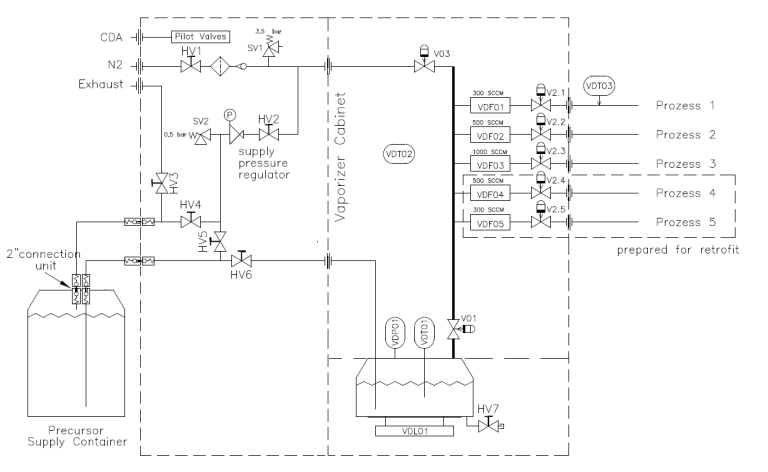
Zu den besonderen Merkmalen unserer Verdampfersysteme gehört, neben der Möglichkeit der Verdampfung ohne Trägergas, die Möglichkeit aus einem Verdampfer mehrere Verbraucher zu versorgen. Es können sowohl mehrere Prozesskammern gleichzeitig versorgt werden als auch an verschiedenen Punkten der Prozesskammer Precursor-Dampf eingespeist werden.
The ability to supply multiple consumers from a single evaporator reduces the number of components, control elements and the space required for installation compared with other designs. Overall, this helps to reduce the costs of maintenance, plant engineering and system integration. Another option is to integrate two evaporators into a single system with a shared control system.
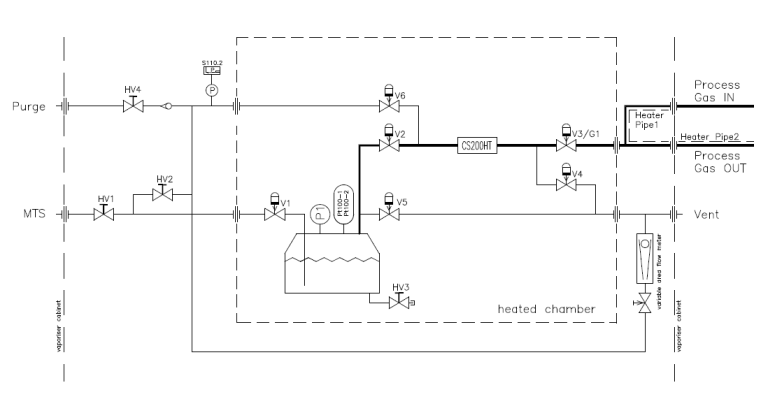
Precursor Verdampfer – Direct evaporation systems (baking)
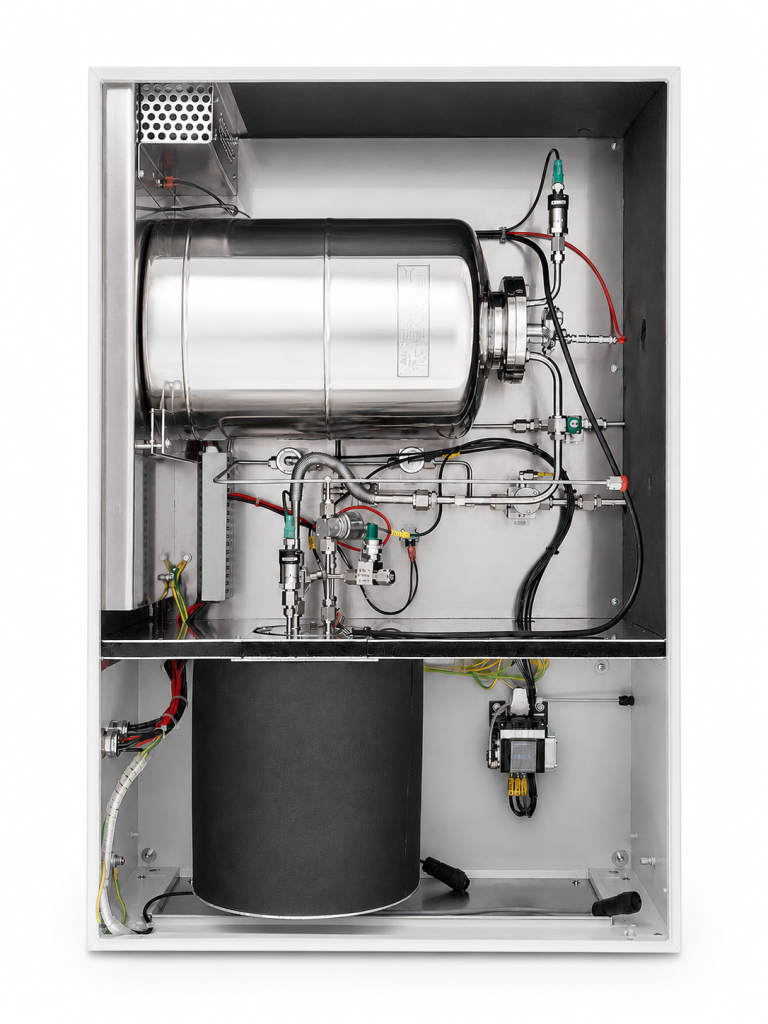
The precursor is fed into a stainless steel tank, the evaporator, where it is regulated to the desired evaporation temperature. The resulting vapour phase is regulated to the set flow rate via a mass flow controller (MFC) and fed into the process. Additional gas streams can be adjusted and fed into the process, irrespective of the required amount of precursor.
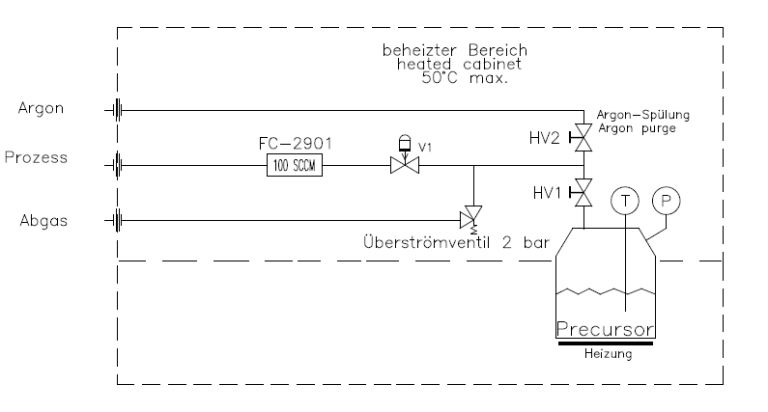
Precursor Verdampfer – Bubbler Verdampfersysteme
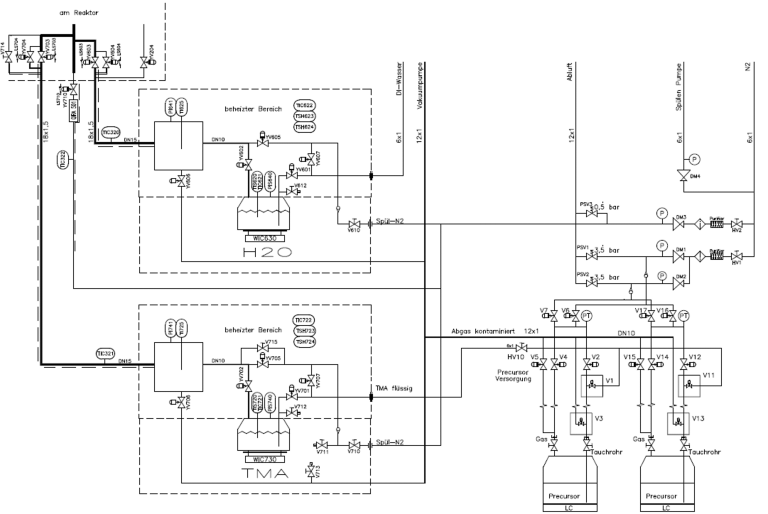
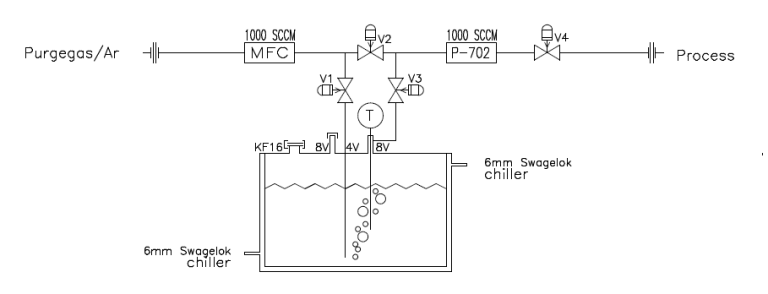
Bubblersysteme dagegen arbeiten mit einem Trägergasstrom zum Austragen des Precursors indem das Trägergas durch ein Vorlagegefäß geführt wird. Diese Systeme sind einfach aufgebaut und ermöglichen in Kombination mit Standardbehältern (z.B. von Dockweiler chemicals) eine kostengünstige reproduzierbare Lösung innerhalb eines, für viele Prozesse ausreichenden, Genauigkeitsbereichs. Durch den Einsatz von zusätzlichen Sensoren kann der Genauigkeitsbereich verbessert werden. Beispielsweise kann ein Feuchtesensor zusammen mit einem Wasserverdampfer eingesetzt werden, um die Feuchtigkeit nach dem Bubbler zu messen. Durch die Zumischung von trockenem Stickstoff lässt sich der benötigte Feuchtigkeitswert erreichen (siehe Befeuchtung AKF Stationen).
Processes in which accuracy is of the utmost importance should, however, favour direct evaporator systems.
Precursor Verdampfer – DLI systems (Direct Liquid Injection)
DLI systems represent another variant. Here, the precursor is evaporated in a metered manner using a liquid flow controller and then mixed with the carrier gas. To enable evaporation at the level of the carrier gas pressure, the gas flow itself is utilised for aerosol formation and evaporation. Process temperatures range from room temperature to well over several hundred degrees Celsius. Owing to the independent flow control of the precursor and carrier gas, these systems achieve a high degree of accuracy in absolute dosing, similar to direct evaporators, but can reach higher maximum pressures.
Such equipment is available on the market from various manufacturers, and we at SIGA GmbH integrate it into our systems as required. However, this complex equipment makes the systems more expensive and must be operated using high-quality media, as replacing the components is considerably more costly than replacing a simple MFC.
Precursor Verdampfer – Charge & Release systems
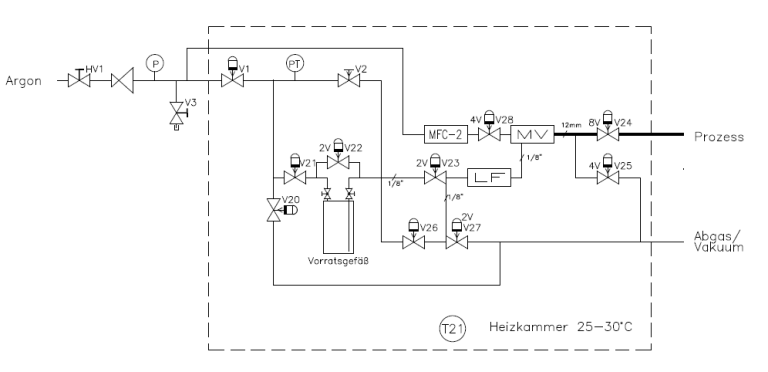
Charge & Release systems dispense without the use of MFCs, based on pressure and volume in a buffer vessel. The buffer vessel is filled with vapour from the evaporator up to a maximum of the current evaporator pressure and then emptied into the process. The dispensed volume can be controlled via pressure differential, temperature and volume. These systems do not require MFCs and allow for the dispensing of small vapour volumes, as required in ALD processes, as well as the short-term delivery of high flow rates. By adjusting the pressure and temperature, as well as using buffer vessels and outlet orifices, reproducible processes can be set up across a wide range of parameters. Furthermore, the systems operate without being limited, for example, by the temperature resistance of MFCs.
Precursor Verdampfer – SIGA GmbH
Die Siga GmbH ist in der Lage alle Arten von Verdampfersysteme aufzubauen und zu applizieren. Ausserdem bauen wir auch Kombinationen der verschiedenen Prinzipien auf wo angebracht um das optimale System zu erreichen oder diesem möglichst nahe zu kommen. So wurden schon Systeme gebaut in denen Direktverdampfer, Baking Verdampfer und Bubbler zugleich im Einsatz sind.
Our evaporator systems feature metal seals; elastomers are not used within the evaporator system. This fulfils a key requirement for safe operation. The system is designed on a bespoke basis according to the specific requirements of each application. The operating temperature of the evaporator is determined by the process pressure and the vapour pressure of the selected precursor and can, for example, range up to 80°C or up to 140°C.
Pressure and temperature within the evaporator are monitored; in the event of overpressure or overtemperature, the evaporator’s heating is switched off. All components carrying precursor vapour are heated. The system is housed in its own enclosure. Pipe trace heating for the vapour line to the process chamber is also fitted if the line pressure so requires.
The pipework and all components in contact with precursor vapour are made of stainless steel, material no. 1.4404, equivalent to SS316L. Face-seal fittings are used, e.g. Swagelok VCR. The utmost importance is attached to ensuring a leak-tight design. Fixed pipe joints are welded using orbital welding under an inert gas atmosphere.
The evaporator can be automatically refilled whilst the process is running. A precursor refill system is used to refill the evaporator. The precursor is stored in a storage vessel and, with the aid of a gas reservoir, is forced out through an immersion tube and fed into the evaporator.
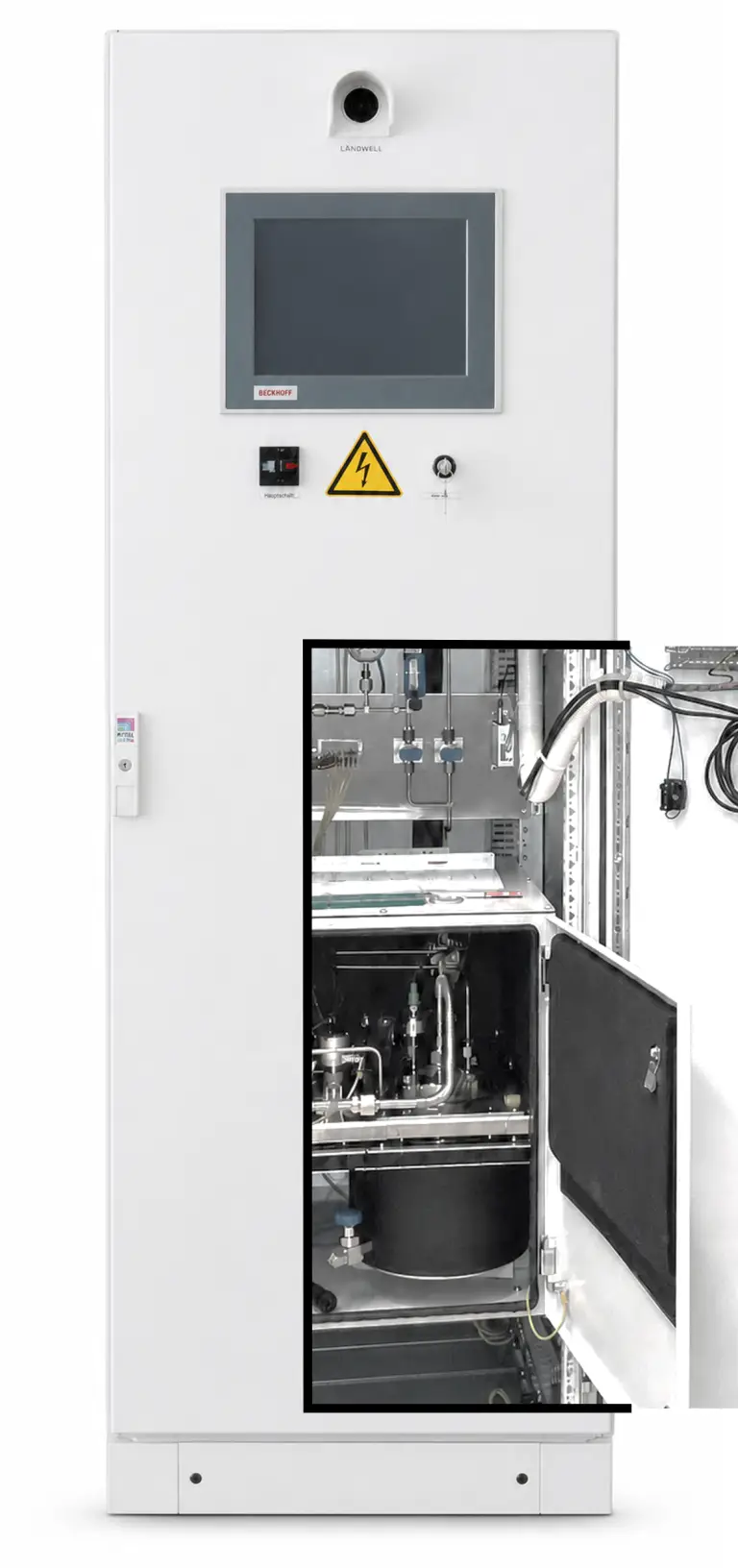
The evaporator is controlled and monitored – including temperature control and automatic refilling – by the evaporator control system via a programmable logic controller (PLC) with a touch-screen for visualisation and operation. All functions are regulated by this control system. The setpoint for the MFCs and the selection of the desired gas path are determined by the higher-level control system of the coating plant. Communication is via a Profibus DP or another serial interface. The details of the control system, such as the type of operation with options for manual intervention and communication with the higher-level control system, are adapted to the requirements of the process.
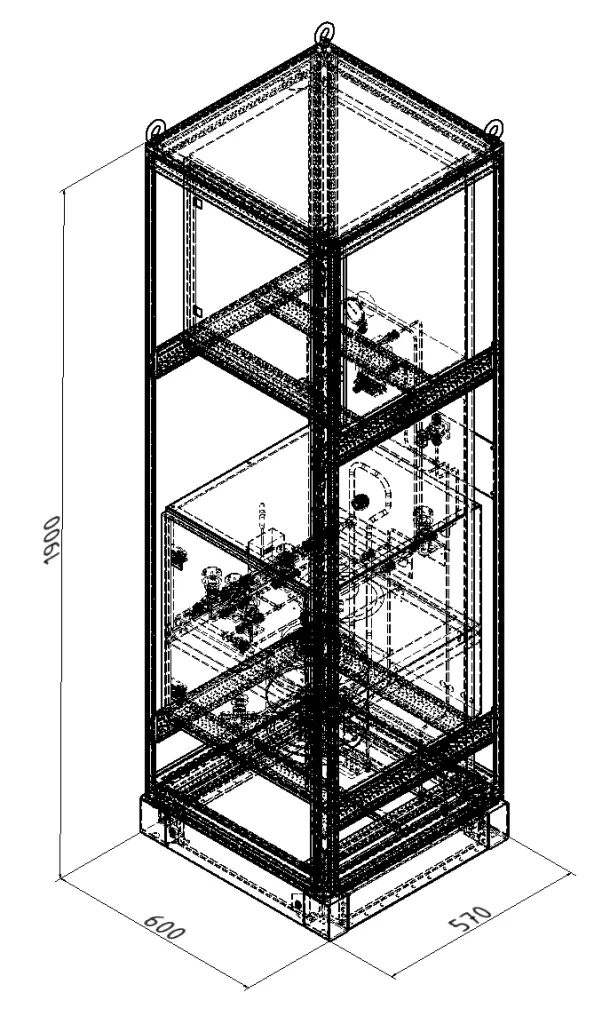
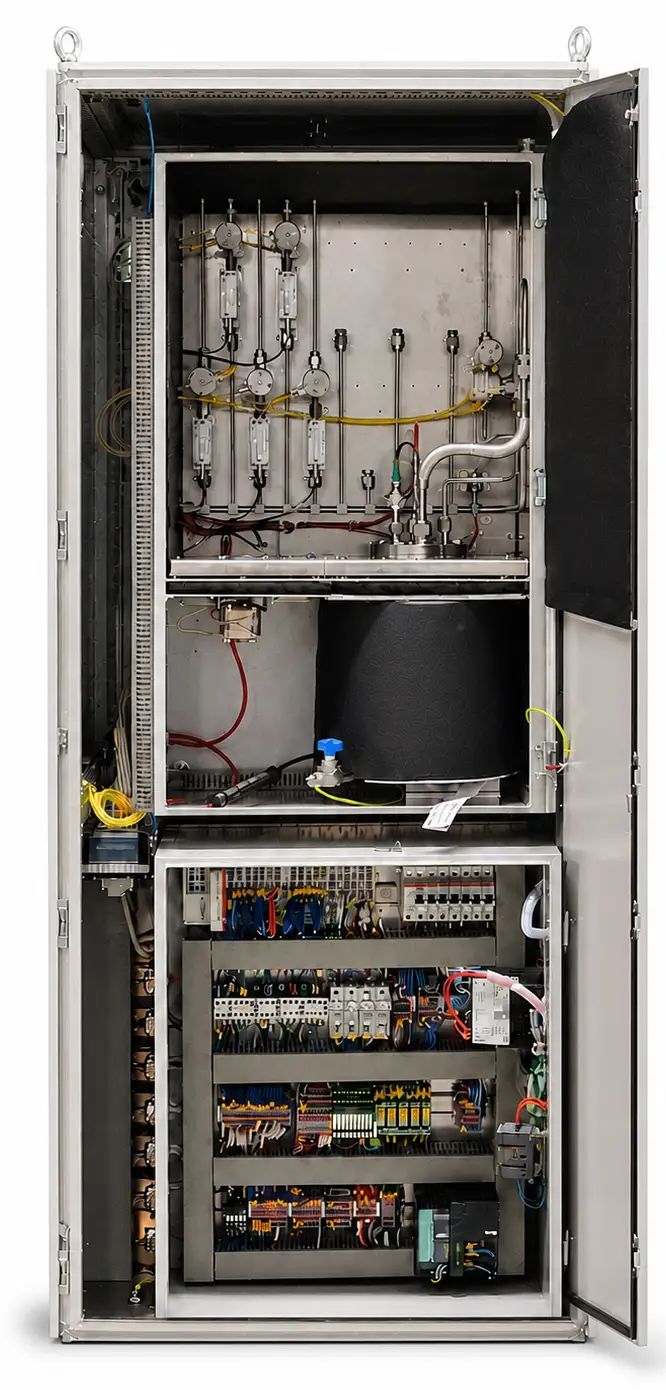
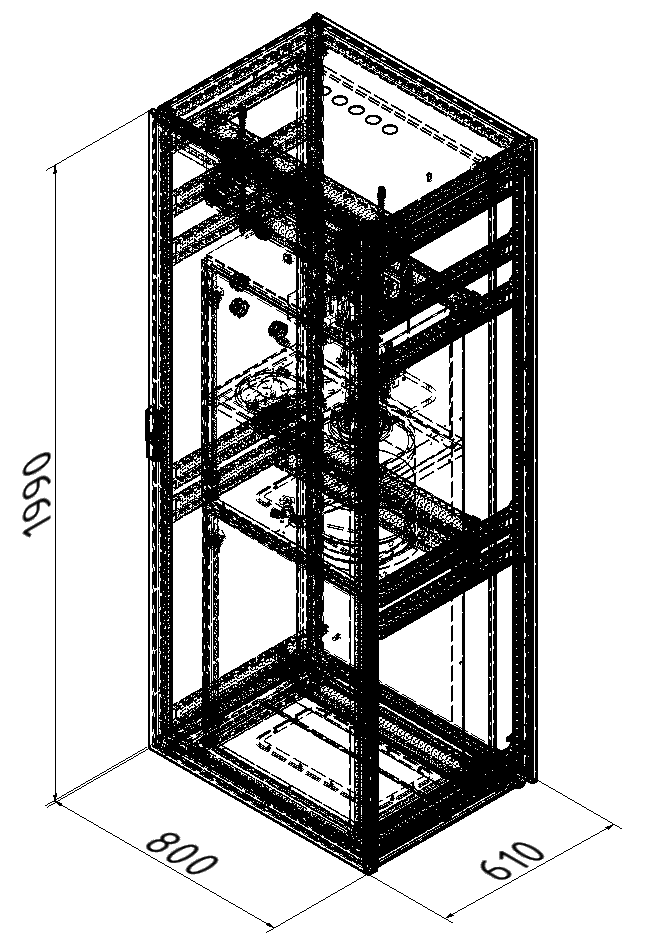
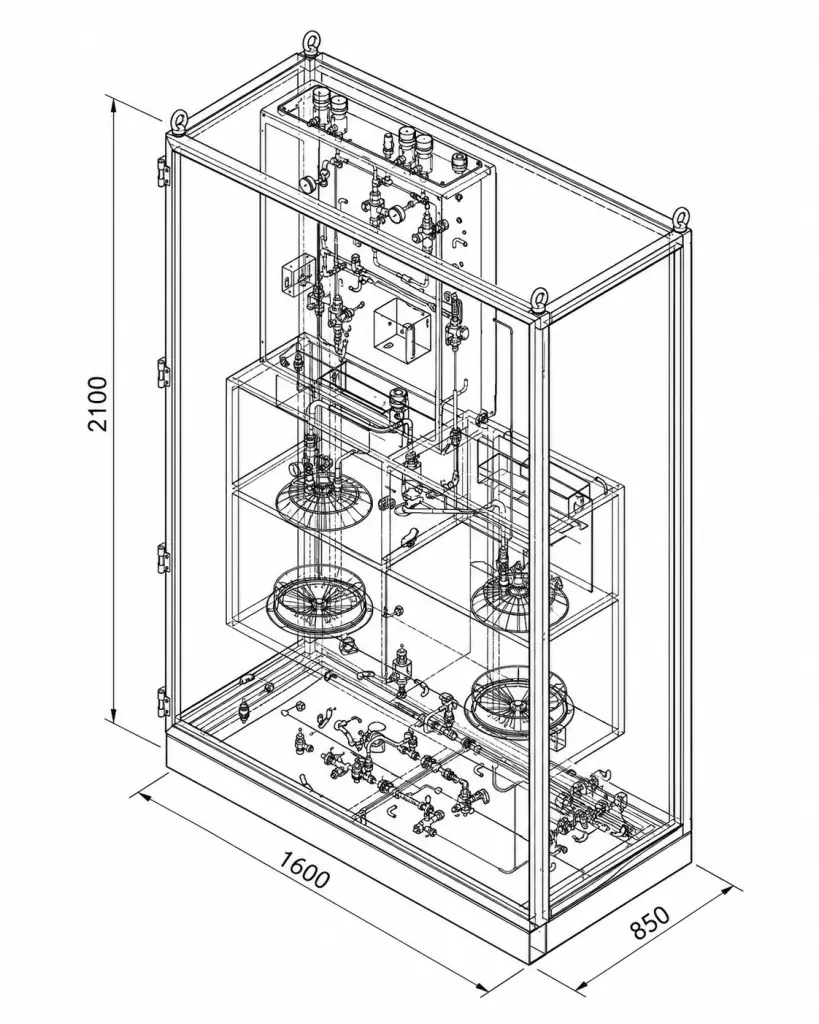
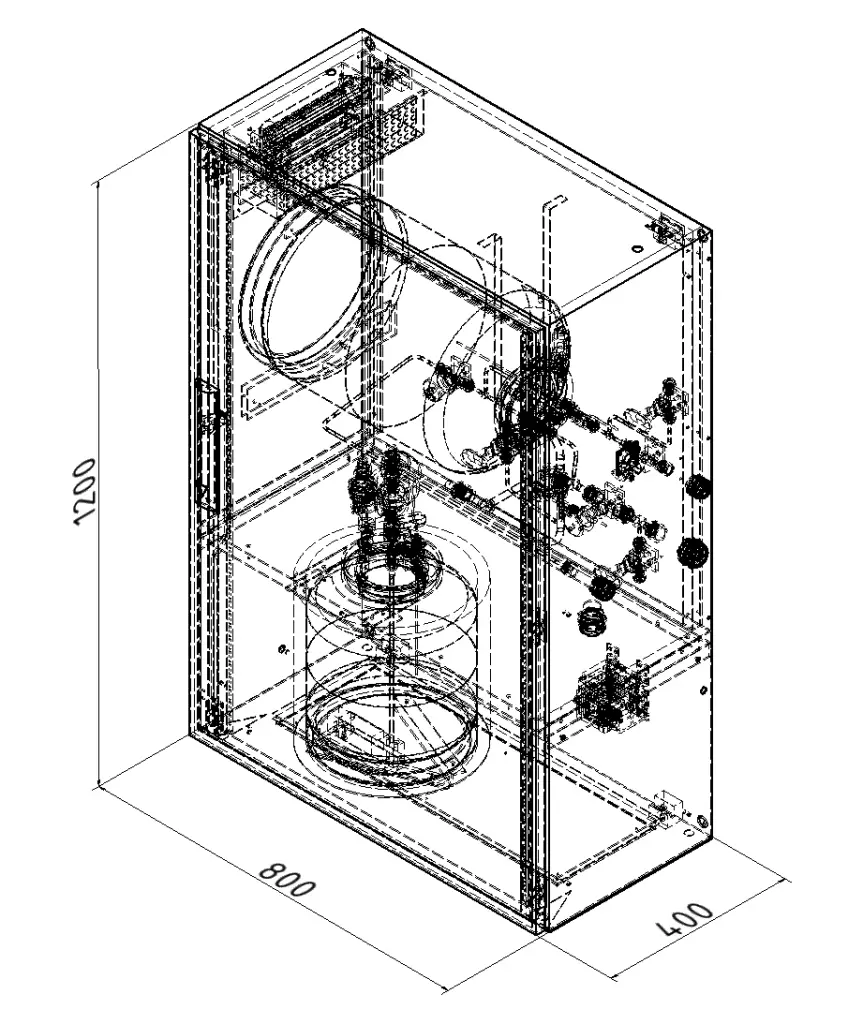
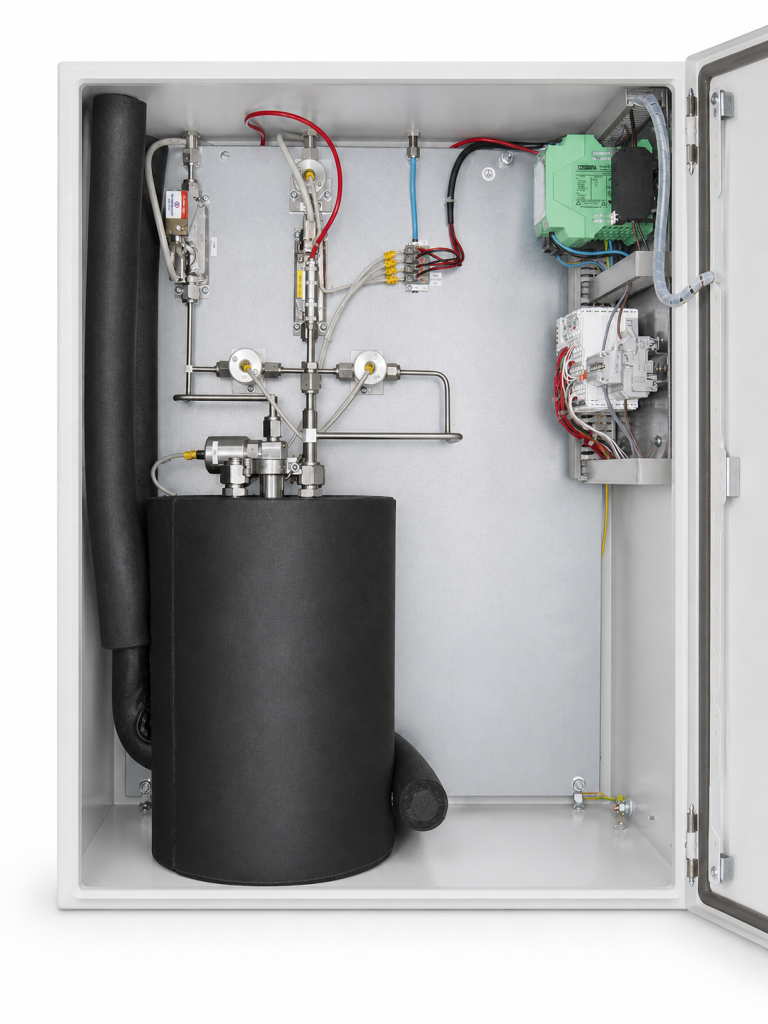
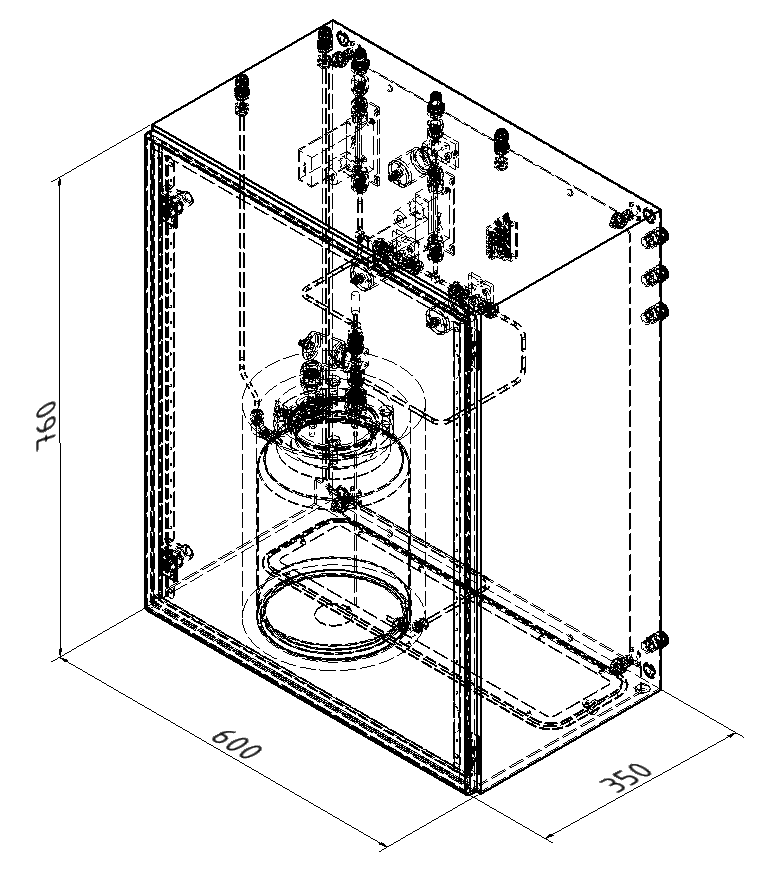
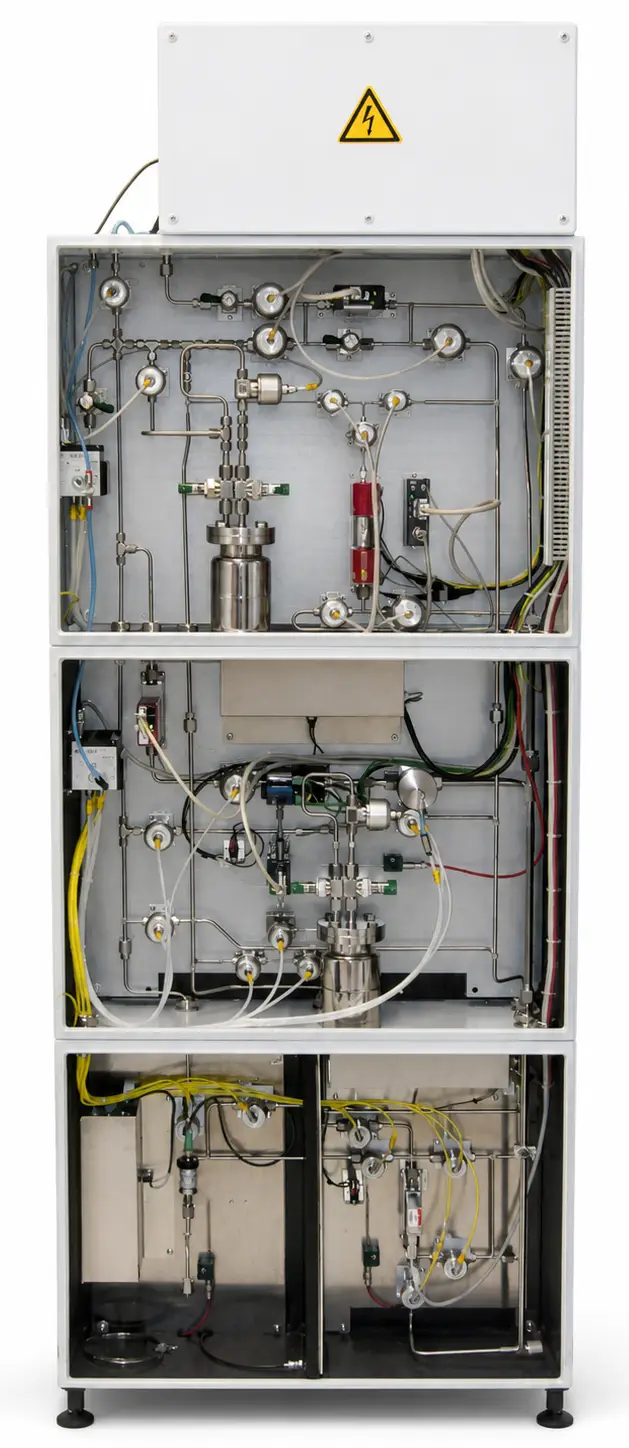
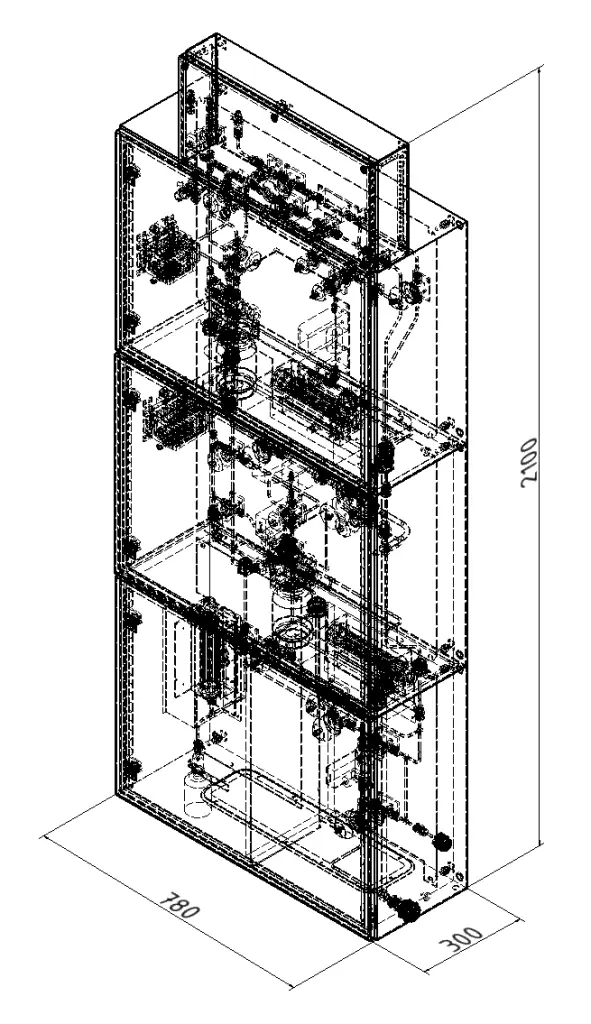
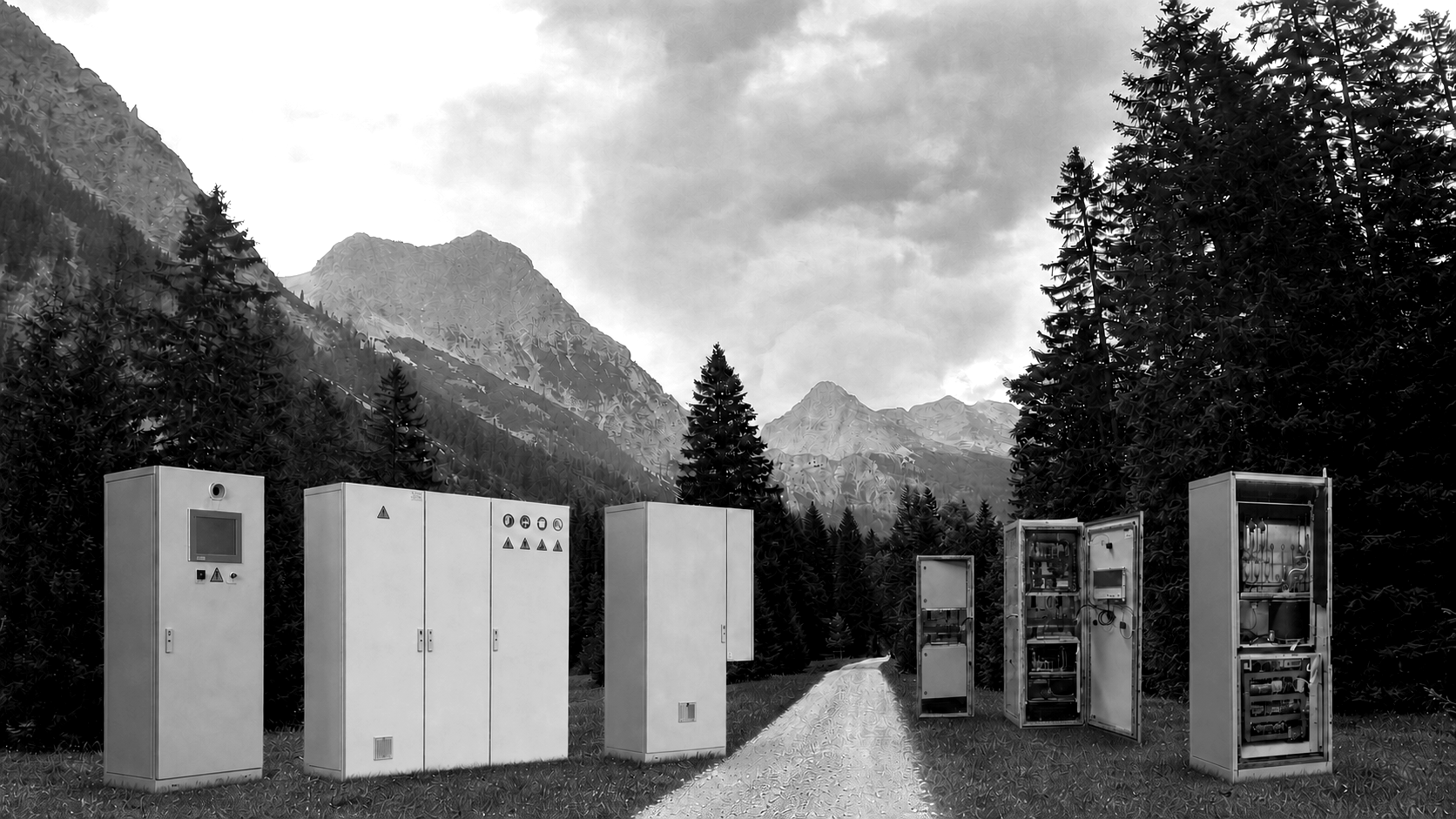
The evaporator systems are installed in suitable sheet steel enclosures or in standard control cabinets. The control unit and evaporator can be integrated into a single cabinet or installed in two separate cabinets. The configuration can be adapted so that the system can be integrated into the coating plant as effectively as possible and tailored to the requirements at the installation site.
The integrated PLC control system with touch screen enables automatic regulation of temperature, pressure and level. Continuous replenishment whilst the process is running can be achieved via an external supply system with a gas reservoir – reliably and user-friendly. Communication with the main plant takes place via Profinet, Ethernet with SecureADS, RS485 or other industry standards.
Neben passiven Sicherheitselementen und geschlossenen Sicherheitsbauteilen wie Sicherheitstemperaturschaltern oder Sicherheitsschwellwertschaltern kommt wenn nötig auch eine Sicherheits SPS (z.B. TwinSAFE) zum Einsatz durch welche die sicherheitskritischen Funktionen geschleust werden und welche diese unabhängig vom eigentlichen Steuerprogramm basierend auf einer Logiktabelle welche aus einer Sicherheitsbetrachtung stammt unterbrechen oder aktivieren kann.
Safety functions such as shutdown in the event of overpressure or overtemperature are an integral part of the control system. The system can be configured modularly: as a stand-alone solution or as a multi-precursor system with central control. Enclosures made of sheet steel or in explosion-proof designs are available, as is integration into existing control cabinets.